


The Art of the IEP
A strong IEP is more than paperwork.
It is a plan whose pieces fit together.
Writing an IEP is an art. Every IEP includes the same essential pieces: present levels, goals, accommodations, services, and progress monitoring. But having all the pieces is not the same as having a coherent plan.
The art is in how those pieces connect—how a student’s needs lead to goals, how goals lead to supports and services, and how progress data shows whether the plan is working.
The Art of the IEP gives educators, families, and specialists a practical framework for evaluating an IEP as a whole, recognizing when the pieces do not fit, and responding when the current plan is not producing meaningful progress.
Use this book to:
Identify goals that are vague or disconnected from the student’s needs
Evaluate whether supports and services match the skills being taught
Use progress data to decide when a plan should change
Bring clearer concerns and questions to the IEP table
The Four-Question IEP Framework
What can the student do now, and where is learning breaking down?
What specific skill are they working to develop?
What will help them learn and practice it?
How will we know if it is working?
AdaptEd handbooks are used in more than 100,000 classrooms.
Each book is designed as a practical reference for planning, meetings, instruction, and team decision-making.
What’s Inside
Measurable Goals — write stronger goals and recognize common problems
Accommodations, Services, and Dosage — determine whether supports match documented needs
The Law in Plain Language — understand IDEA, FAPE, LRE, and the Endrew F. standard
Behavior Inside the Plan — connect FBAs, BIPs, and goals to the skills a student needs to build
When the Plan Is Not Working — follow a six-step response when progress stalls
Seven Reproducible Tools — review goals, prepare for meetings, and evaluate the plan
This book explains the federal IDEA framework. States may add their own requirements.
This is not a compliance manual, a walkthrough of your state’s IEP software, a generic goal bank, or legal advice. It does not tell you what to teach. It teaches the table how to tell whether a plan is any good — the critical skill that nobody trains.
Formats and Book Details
Digital PDF Only — delivered immediately by email and fully searchable
Spiral Bound — an 8.5" × 11" physical reference designed to lie flat
Spiral-Bound + Digital PDF — includes both formats
Length: 126 pages
Edition: First edition, 2026
Interior: Grayscale with a full-color cover
Included Resources: Seven reproducible tools
The purchaser may print one complete copy for personal use and reproduce individual pages for students in their own classroom or caseload. Schoolwide, districtwide, organizational, and multi-user reproduction is not permitted.
Who This Book Is For
Special and General Education Teachers
Parents and Caregivers
SLPs, OTs, PTs, School Psychologists, and Paraprofessionals
Administrators, Instructional Coaches, and Teacher Preparation Programs
Frequently Asked Questions
Does this book apply in every state?
It explains the federal IDEA framework. States may add their own requirements.
Is this a goal bank?
No. It teaches readers how to evaluate and write measurable goals.
How is the digital PDF delivered?
It is delivered by email immediately after purchase.
What may I print or reproduce?
The purchaser may print one complete personal copy and reproduce individual pages for students in their own classroom or caseload. Distribution to additional educators, schools, districts, organizations, or professional-development participants is not permitted.
Full Table of Contents
Buying for a school, district, or university?
AdaptEd accepts institutional purchase orders. Email service@adapted4specialed.com for assistance.


Social Skills Story: Period Cramps | Menstrual Pain & Puberty Education Editable
This Period Cramps Social Skills Story is a supportive and neurodiversity-affirming resource designed to help individuals understand menstrual cramps and the physical sensations that come with menstruation. Ideal for both home and special education settings, this story breaks down what cramps are, why they happen, and how to find comfort — using simple, clear language and real-life images to reduce anxiety and build self-care confidence.
What's Included:
A visual social story that explains menstrual cramps, what they feel like, and why the body experiences them, using easy-to-understand language.
Step-by-step guidance on coping strategies including warmth, rest, breathing techniques, and safely taking medicine with a trusted adult.
Editable components that allow customization for individual needs, making this resource adaptable for various environments, including home, school, or therapy.
Why You'll Love It:
Written with a neurodiversity-affirming approach, this story is respectful and inclusive, helping individuals understand that cramps are a normal part of menstruation — not a sign that something is wrong.
The editable format allows you to personalize the content to suit the specific needs of your child or student, whether at home or in a classroom setting.
Visual supports and clear language make it accessible for individuals with a range of developmental and cognitive differences, helping them feel informed and prepared rather than scared.
How It Helps:
Ideal for use in home, school, or therapy by parents, educators, and caregivers working with individuals with autism, ADHD, intellectual disabilities, or other neurodivergent identities.
Reduces anxiety and confusion around period pain by providing clear, factual, and comforting information about what cramps are and how to find relief.
Builds independence and self-advocacy in managing menstrual discomfort, giving individuals the tools to recognize cramps, communicate their needs to trusted adults, and care for their bodies with dignity.


When Learning Hits the Wall
When learning gets stopped in its tracks, something is in the way.
Our newest handbook, When Learning Hits the Wall, helps educators make sense of those moments—when a student shuts down, rushes through work, or simply disengages—and respond with clarity instead of guesswork, even when they’ve already tried “everything.”
It focuses on helping identify what system is breaking down in the moment and what needs to change so learning can resume. The book introduces a practical, research-grounded, barrier-based framework for matching support to real barriers—while keeping learning goals intact.
Choose Digital, Print, or Both to access When Learning Hits the Wall.
How This Book Supports Educators, Teams, and Families
Better understand why learning breaks down in the moment
Respond to shutdowns, rushing, and disengagement with clarity
Match support to what’s blocking access
Keep learning goals intact while restoring access to learning
Who this is for (and who it’s not)
Teachers in inclusive classrooms who need practical, in-the-moment ways to respond when students shut down, freeze, rush through work, or disengage
Educators asked to “differentiate” or “provide accommodations” without a clear framework for deciding what actually needs to change
Teachers supporting twice-exceptional, undiagnosed, or inconsistently accessing learners, where needs shift depending on task, pace, or environment
School leaders and instructional coaches working to improve consistency and accuracy in support decisions across classrooms
IEP and problem-solving teams frustrated by vague accommodations (like “preferential seating” or “extra time”) that don’t reliably restore access
Teams seeking clarity without increasing documentation or compliance burden
Parents and caregivers trying to understand why supports aren’t working—not just what supports are being used
What’s inside
This book provides a clear, repeatable way to understand why learning breaks down—and how to restore access when it does.
First: A practical framework for identifying learning breakdownsLearn how to better identify what’s actually getting in the way when a student freezes, shuts down, rushes, or disengages.
Then: A shared language for understanding barriersClarifies the difference between task demands, domains, hidden barriers, and access conditions—so decisions stay focused and consistent.
At the core: The six hidden barriers that drive most learning strugglesClear explanations of processing speed, working memory, task initiation, attention shifting, organization & sequencing, and regulation load—with real classroom examples.
Tools for identifying barriers in the momentQuick scans, flowcharts, and observation prompts designed to support real-time decisions, not after-the-fact analysis.
Guidance for matching support to the barrier—not the behaviorLearn when accommodations restore access, when modifications are appropriate, and why good intentions sometimes lead to the wrong support.
Barrier-based accommodation examples that actually generalizePractical ways to adjust pace, language, structure, and conditions so students can engage with the same learning goals.
Disability snapshots as starting points—not conclusionsADHD, autism, dyslexia, DLD, mental health, intellectual disability, trauma, and TBI—included to support observation and context, not to prescribe support.
Language that protects dignity and restores accessScripts and framing that help students re-enter learning without increasing pressure, shame, or confusion.
This book is designed to be used flexibly—read cover to cover, referenced during planning, or pulled out in the middle of a tough moment when learning hits the wall.
Below is the full table of contents, so you can see exactly how the framework is structured.
Formats, delivery & purchase orders
📦 Spiral-bound print
💻 Digital PDF — instant access
Purchase orders accepted. Email service@adapted4specialed.com


THE SLP’S GUIDE TO AAC: From Assessment to Implementation
AAC Handbook for SLPs
The SLP’s Guide to AAC: From Assessment to Implementation
AAC shouldn’t require guesswork… but most SLPs are left guessing.
Most SLPs were never taught how to complete a full AAC assessment, choose the right system, or support teams—yet the moment an AAC user lands on your caseload, you’re expected to know it all.
This handbook gives you the structure, clarity, and confidence you should have been handed on day one.
Created by Megan Mott, M.S., CCC-SLP—an experienced, neurodivergent SLP—this guide is the step-by-step reference clinicians wish they had from the start.
Complete AAC assessments with confidence
Understand how to match the right system to the right communicator
Support teams so AAC doesn’t fall apart in real classrooms
Built for real-world SLPs
What You’ll Be Able to Do with This Guide
Complete AAC assessments with a clear, repeatable process
Choose systems & features that line up with communication needs
Train teams without overwhelming them
Model AAC without pressure or unrealistic expectations
Support emergent & conventional literacy for AAC users
Document clearly for IEPs, schools, and insurance
Stop guessing—and start leading AAC teams
Why This Handbook Is Different
This guide doesn’t just talk about AAC—it walks you through the entire process with clear visuals, examples, and real-world guidance.
Move from “I’m not sure what to do next” to “I know exactly how to approach this communicator, this team, and this setting.”
Table of Contents (What’s Inside)
Here’s a readable look at what’s inside the handbook:
Chapter 1: AAC Fundamentals
Who Uses AAC?
Types of AAC
Types of AAC Access
Types of AAC Tools
Chapter 2: AAC Core Values
Different, Not Less
Autonomy
AAC Myths and Truths
Chapter 3: AAC Modeling & Practices
Types of Vocabulary
What Is Motor Planning?
What Is Modeling?
Model Without Expectation
Attribute Meaning
Validate All Communication
Reasons People Communicate
Necessary AAC Strategies
Practices to Avoid
Chapter 4: AAC Competencies
Ask Yourself
Chapter 5: AAC Classroom Tips & Ideas
Communicating for a Variety of Purposes
Chapter 6: AAC & Literacy
An Expanded View of Literacy
Determining the Level of Instruction
Emergent Literacy Instruction
Conventional Literacy Instruction
Assistive Technology & Literacy
Chapter 7: AAC Assessment
Feature Matching: Access Method
Feature Matching: Symbol Features
Feature Matching: Linguistic Features & Vocabulary
Feature Matching: Voice Features
Feature Matching: Display Features
Feature Matching: Positioning & Portability
Feature Matching: Additional Features
AAC Funding Overview
The Assessment Process
Part 1: Gather a Case History
Part 2: AAC Trials
Part 3: Device Recommendations & Documentation
Chapter 8: Appendix
How Big Is the Problem for Me?
Play Activities
AAC Data Sheets
AAC Modeling & Implementation
Learn what implementation looks like when it’s ethical, effective, and doable for busy teams.
Model AAC without expectation or pressure
Introduce AAC in supportive, safe ways
Problem-solve when teams aren’t modeling
Validate all communication—not just words
Avoid common AAC pitfalls (and understand why they matter)
AAC & Literacy
Find practical routines for emergent and conventional literacy—paired with assistive technology supports that make sense in real classrooms.
Tools & Templates Included
Data sheets for all AAC competencies
Device trial templates
Team-training reminders
Lesson ideas
Quick-reference charts
Checklists & guides
Documentation supports
Format Options
Choose the Format That Fits Your Workflow
Physical handbook – premium soft-touch cover, premium paper, and durable metal binding.
Digital PDF – searchable, portable, and ideal for team meetings.
Bundle: Physical + Digital – get both formats for maximum flexibility.
Use the format that makes it easiest to build AAC systems that actually work.
AAC doesn’t have to feel overwhelming or improvised.
The SLP’s Guide to AAC: From Assessment to Implementation gives you the clarity, structure, and confidence every SLP deserves—so you can stop guessing and start leading.


The Tower Treasure — Adapted Novel Study for Students with Significant Support Needs
A real chapter-book experience for students with significant support needs.
Many students with significant intellectual, communication, or learning needs spend years on short passages, simplified stories, and isolated worksheets, without ever getting to follow a chapter book from beginning to end.
The Tower Treasure changes that. Across 17 adapted chapters, students meet the characters, follow the mystery, notice clues, make predictions, answer questions, and come back week after week to find out what happens next.
17adapted chapters
700+Google Slides
17weeks of instruction
3printable journal formats
Written by a speech-language pathologist. Works with any AAC system. Instant download for projector, board, or tablet.
Everything included
17 fully adapted chapters of The Tower Treasure, rewritten in clear, accessible language
700+ Google Slides covering roughly 17 weeks of instruction
Visuals for important people, places, and events
What, who, and where preview questions for every chapter
Multiple-choice and open-ended comprehension questions
Interactive "try again" feedback when a student misses a question
Look-back screens that send students back into the story to find the answer
3 printable journal formats per chapter: cut-and-paste, fill-in-the-blank with word bank, and independent writing
Editable AAC icons to match your students' systems
Optional sensory items and tangible extensions for each chapter
Preview Chapter 1 free and see exactly how a lesson runs before you buy.
A chapter book they can actually be part of
The language is made more accessible. Visuals support understanding. Predictable routines help students know what comes next.
Students can participate by speaking, pointing, selecting an answer, partner-assisted scanning, using AAC, or writing.
The supports are substantial on purpose, but the experience still feels like a real book.
What does a week actually look like?
Students learn one predictable routine and use it through all 17 chapters:
Preview: What? Who? Where? questions introduce key people, places, and events.
Read: students follow the adapted chapter with clear language and visual support.
Answer: multiple-choice and open-ended questions check understanding.
Look back: students return to the story to find information and try again.
Journal: students respond using one of three differentiated printable formats.
The routine stays familiar while the mystery keeps changing.
What happens when a student gets it wrong?
They aren't simply marked wrong. They get a "Whoops, try again" screen and are directed back to the part of the story that can help them find the answer. Then they try again.
Students practice looking back at the text, finding information, and using what they read, all while continuing to solve the mystery.
Who is this for?
This resource was created for students who are too often left out of traditional chapter-book experiences, including students with:
Significant intellectual disabilities
Complex communication needs
Emerging literacy skills
Significant language and learning needs
AAC systems and other alternative ways to communicate
The content is written for older elementary through high school (roughly grades 3 to 12): mystery, danger, and problem-solving, not "little kid" plots. Mixed-age groups can read the same story together while you adjust the questions and response formats for each student.
Do my students need AAC to use this?
No. Visuals, accessible language, repetition, predictable routines, reduced writing demands, and multiple ways to respond make the story accessible to a much wider range of students with significant needs.
If your students do use AAC, the resource works with any system. Core-word-rich language, AAC modeling prompts, and editable icons let you match the visuals to whatever device or board your students already know.
Whole group, small group, or 1:1?
All three. Project the slides for shared reading and group discussion, pause to model responses on students' systems, use the comprehension questions as exit tickets or informal data, and extend with the printable journals.
Plan on roughly one chapter per week for a semester-long unit, or adjust the pacing to fit your group.
Can I buy this with a school purchase order?
Yes. Visit our purchase orders page for school and district ordering, or email service@adapted4specialed.com.
One mystery. Seventeen chapters.
Students aren't completing 17 disconnected reading passages. They're following the same characters, noticing clues, making predictions, looking back for answers, and coming back week after week to find out what happens next.
Because needing significant support shouldn't mean missing out on the experience of following a real story.
Read together. Follow the mystery. Find out what happens next.
Get the 17-Chapter Novel Study — $59.97
Instant digital download. Google Slides plus printable PDFs. Rated 4.8/5 by 3,355 customers.


Safe to Learn Handbook
The Foundations of Co-Regulation, Trauma-Informed Practice, and Inclusive SEL
“Practical, real, and exactly what educators need right now.”— Alissa Kostopoulos, BCBA
Before students can learn, they must feel safe. Safe to Learn bridges the gap between big ideas and daily practice—giving teachers, administrators, support staff, and families tools they can use right away.
✨ What’s Inside
Regulation before expectation → why nervous system safety is the first curriculum.
Daily co-regulation strategies → go beyond “calm down” scripts to build real connection.
A trauma-informed lens → reframe fight, flight, freeze, and fawn as survival—not misbehavior.
Explicit teaching of self-regulation → build routines instead of assuming students “just know.”
UDL & sensory checklists → design classrooms where every student feels safe.
Family + caregiver guides → bridge support between home and school.
Leadership reflection tools → help admins model regulation and reduce burnout.
🛠 Tools You’ll Use Right Away
Reflection guides for educators & leaders
Family–school collaboration checklist
One-page caregiver guide to co-regulation
Administrative walkthrough forms & classroom maps
Strategy banks, sensory supports, and explicit teaching examples
📦 Choose Your Format
Digital PDF → instant access
Spiral-Bound Print → lays flat, perfect for PD
Bundle (Best Value) → both for the price of print during early release 🎉 Limited-time offer
💡 Why It Matters
When students feel safe, they don’t just behave better—they learn better.When educators feel equipped, they don’t just survive—they thrive.
Choose your format and start building safer, stronger schools.

00
DAYS 00
HRS 00
MIN 00
SEC
DAYS 00
HRS 00
MIN 00
SEC
AAC Core Word Builder: Complete Bundle | 60 Weeks of No-Prep Speech Therapy Lessons | Sets 1-3
Just 80 words make up about half of everyday English. This is the curriculum that teaches them—systematically, across a full school year.
AAC Core Word Builder: The Complete Bundle brings together all three sets of Meg Mott's structured AAC curriculum—60 weeks of ready-to-use lessons designed to turn foundational core vocabulary into real, generalized communication.
Created by Meg Mott, M.S., CCC-SLP, AdaptEd's resident AAC specialist and parent of an autistic son. Originally built for teletherapy in 2020 and refined across years of real classroom and clinic use, this curriculum is now trusted by SLPs, special educators, and AAC teams across the country.
Buy the bundle and save $30 versus purchasing Sets 1, 2, and 3 individually.
Why core words matter
Just 80 words make up about half of the English we use every day. These foundational words are how students share what they want, need, and feel—and they're the bridge between isolated vocabulary and real communication.
For many students with complex communication needs, reaching those first words can feel out of reach. Without structured, sequenced instruction, core vocabulary stays locked behind frustration. AAC Core Word Builder is the systematic program that changes that—giving you 60 weeks of expert-designed lessons that move students from recognizing words to actually using them, across settings, with the people who matter.
What makes this curriculum different
This isn't a stack of flashcards or a pile of worksheets. Every week of instruction is built around one core word and seven coordinated activities—designed to engage students through multiple modalities, build regulation into the lesson, and extend learning beyond the session.
Introductory games — low-pressure practice that makes new words stick without performance pressure
Animated adapted books — real images and movement on every page to hold attention and reinforce the word in context
Movement breaks — regulation built in, tied to the target word, so students stay engaged and focused
Bonus activities — songs, videos, guided drawings, and book extensions that deepen learning across the week
Parent handouts — clear guidance for families so vocabulary actually generalizes to home
Homework — simple reinforcement that extends progress across settings, easily shared electronically
You're not just teaching words. You're giving students the tools to use those words in authentic conversations, across environments, with the people who matter most.
Who this is for
SLPs who want a structured, evidence-aligned AAC curriculum without spending Sundays building lessons from scratch
Special education teachers supporting students with complex communication needs across a full school year
Teletherapy and hybrid clinicians who need engaging, screen-friendly materials that hold attention across digital sessions
AAC teams looking for shared lesson materials that align across providers, classrooms, and home
Parents wanting to extend AAC learning at home with structured guidance, not generic suggestions
What's inside: 60 weeks of lessons
The complete curriculum is divided into three sets, each introducing 20 weeks of high-frequency, functional core vocabulary. Together they provide a full school year of systematic AAC instruction.
Set 1 — Weeks 1–20The foundation: words that get students moving, asking, and connecting.
Go (2 weeks) · Turn (2 weeks) · Not/Don't (2 weeks) · Eat · Come · Put · Help · Like · Open · Want · All Done · More · What? · I/You · On · Off · Drink
Set 2 — Weeks 21–40Building on the foundation: regulation, evaluation, and richer interaction.
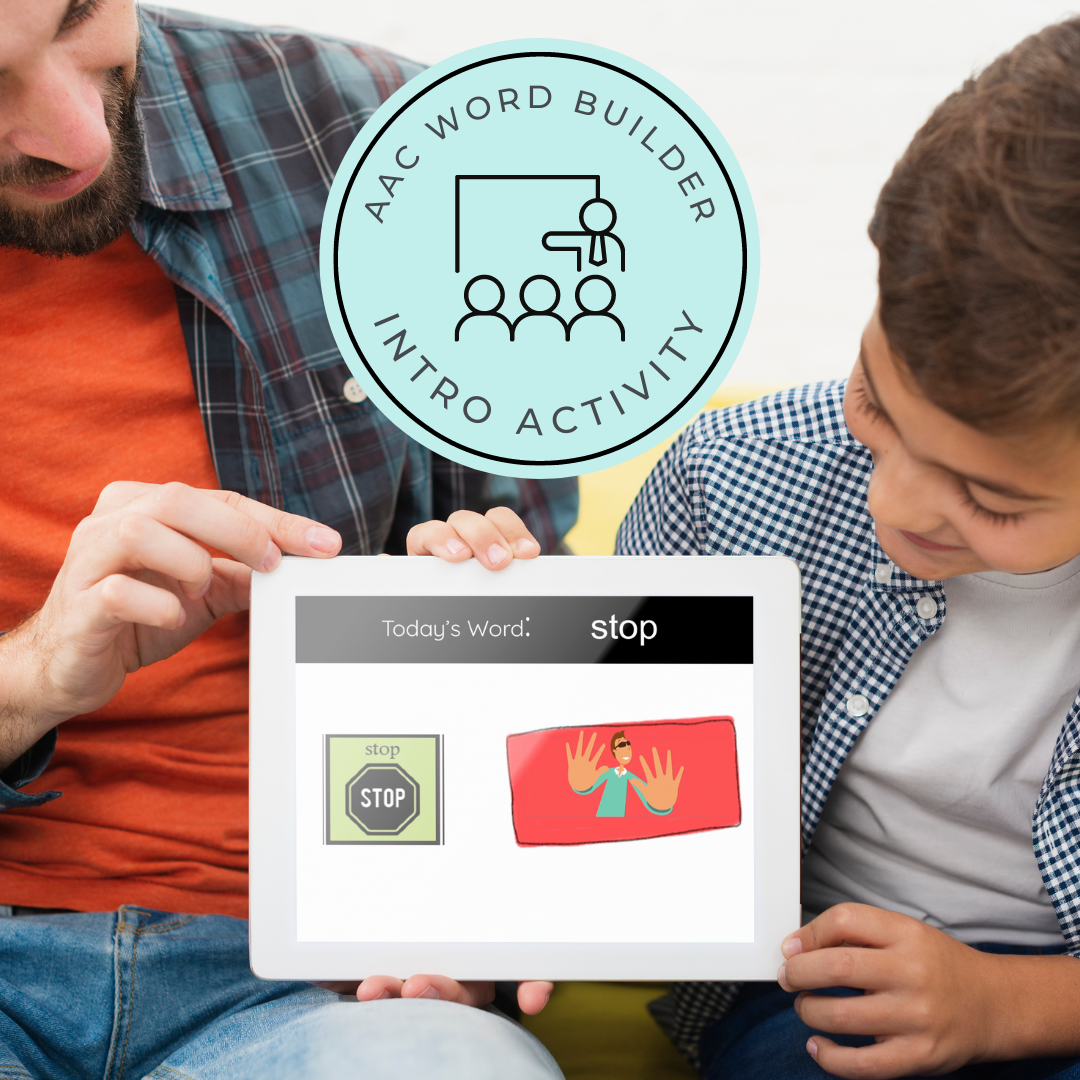
Stop · Get · Look/See · Up · Good · Make · Work · In · Who · Read · Different · Bad · Hear/Listen · Take · Do · Again · Wait · Happy · Sick · Out
Set 3 — Weeks 41–60Completing the year: descriptive language, emotional vocabulary, and forward motion.
All · Little · Where · Big · Silly · Watch · Sad · Some · Down · Dirty · Clean · Feel · Give · Fast · Slow · That · When · Ready · Away · All Gone
Note: In Set 1, three high-utility words (Go, Turn, and Not/Don't) receive two weeks of instruction each because their frequency and functional reach justify the deeper repetition. This is intentional pacing, not padding.
Bundle savings
Set 1 individually: $59.99
Set 2 individually: $59.99
Set 3 individually: $59.99
Complete Bundle: $149 — save $30
Buy the bundle once. Use it across a full school year. Reuse it every year after. The savings start at checkout; the value compounds across every cohort of students you support.
Formats, delivery & purchase orders
💻 Digital download — instant access after purchase
📱 Works on iPad, laptop, Chromebook, or any device with internet access
🎓 Compatible with teletherapy, push-in, pull-out, and home use
Purchase orders accepted. Email service@adapted4specialed.com


Pathway to Support Handbook
Stop Guessing. Start Aligning.
Because when everyone is trying—but support still isn’t working—guessing isn’t the solution.
Pathway to Support is a practical handbook for educators, families, and support staff who are tired of piecing strategies together and want support plans to actually work in real life.
No more trying strategies in isolation.
No more meetings that go in circles.
No more plans that look solid on paper but fall apart in practice.
What This Handbook Gives You
Cross-disciplinary guidance that connects classroom practice, therapy strategies, and system-level insight.
A simple, repeatable framework for navigating big emotions: Regulate → Connect → Plan.
Real-world examples and tools that keep teams aligned across roles and settings.
Practical supports you can use right away—without theory overload.
Ready to stop piecing support together?Choose Digital, Print, or Both to start using Pathway to Support today.
What you’ll actually use this for
✅ Quick-Reference Support Tools
Real classroom case studies that show what works—and how to adjust when it doesn’t
Sensory strategies that support regulation, focus, and readiness to learn
Accessible communication tools you can use across learners and settings
Clear, practical accommodations with examples you can apply immediately
✅ Real-World Support (Not Just Theory)
A simple 3-step plan for high-emotion moments: Regulate → Connect → Plan
Step-by-step examples across classrooms, homes, and therapy spaces
SMARTIE goal templates that simplify documentation and keep progress visible
Collaboration tools that keep educators, therapists, families, and administrators aligned
Who this is for (and who it’s not)
This handbook is especially helpful if:
The IEP looks solid—but the supports still aren’t working
Everyone on the team is trying, but not in the same direction
You’re tired of escalating plans without meaningful change
You want fewer “what do we try next?” moments—and more clarity
Not a scripted program. Pathway to Support is a practical guide you can adapt to your students, your setting, and your role—whether you’re in the classroom, the therapy room, or supporting at home.
What’s inside (a closer look)
Case studies that show how support breaks down—and how to adjust
Regulation supports to reduce escalation and increase readiness
Communication supports to improve access across contexts
Accommodation examples that are practical, specific, and usable
Goal + documentation tools to keep progress clear and manageable
Collaboration supports that reduce friction and keep teams aligned
Support for the adults doing the work—reassurance and perspective
Meet the authors
Written by a cross-disciplinary team of trusted voices in special education.
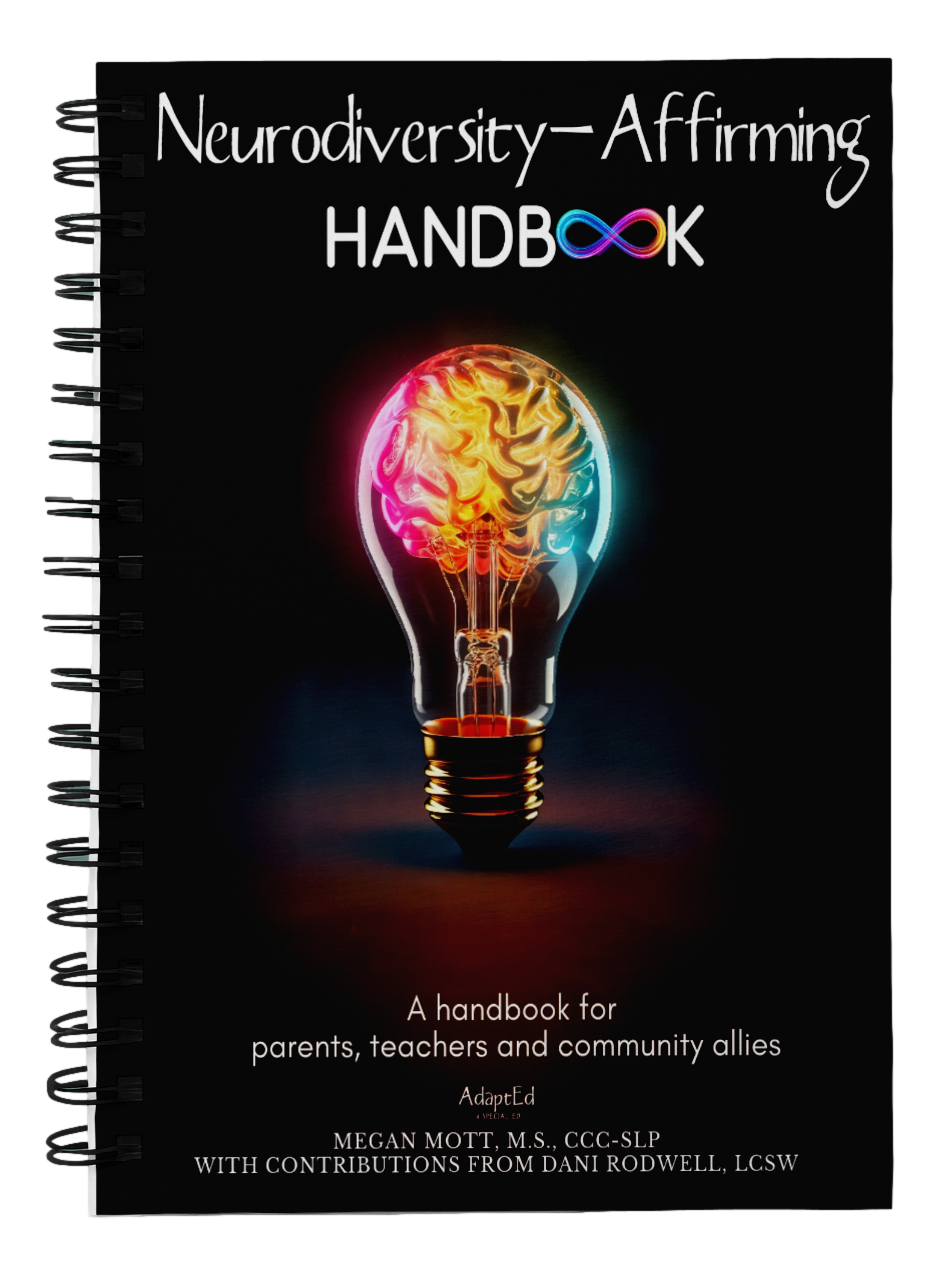
👩🏫 Meg Mott, M.S., CCC-SLP — Author of The Neurodiversity Affirming Handbook and Navigating Neurodiversity
👨💼 Eric Oxford, Ed.D. — District leader in special education
👩⚕️ Tami Santisteban, M.S., OTR/L — School-based occupational therapist
👩🎓 Filiz Zeybek, Ed.D. — Special educator and instructional designer
Formats, delivery & purchase orders
📦 Print Edition — High-quality handbook shipped to your door
💻 Digital Edition — Instant download so you can start right away
🛒 Bundle Option — Get both formats for the same price as print
Need a PO? Email service@adapted4specialed.com
Pathway to Support helps you move from uncertainty to alignment—so support plans don’t just exist, they work.
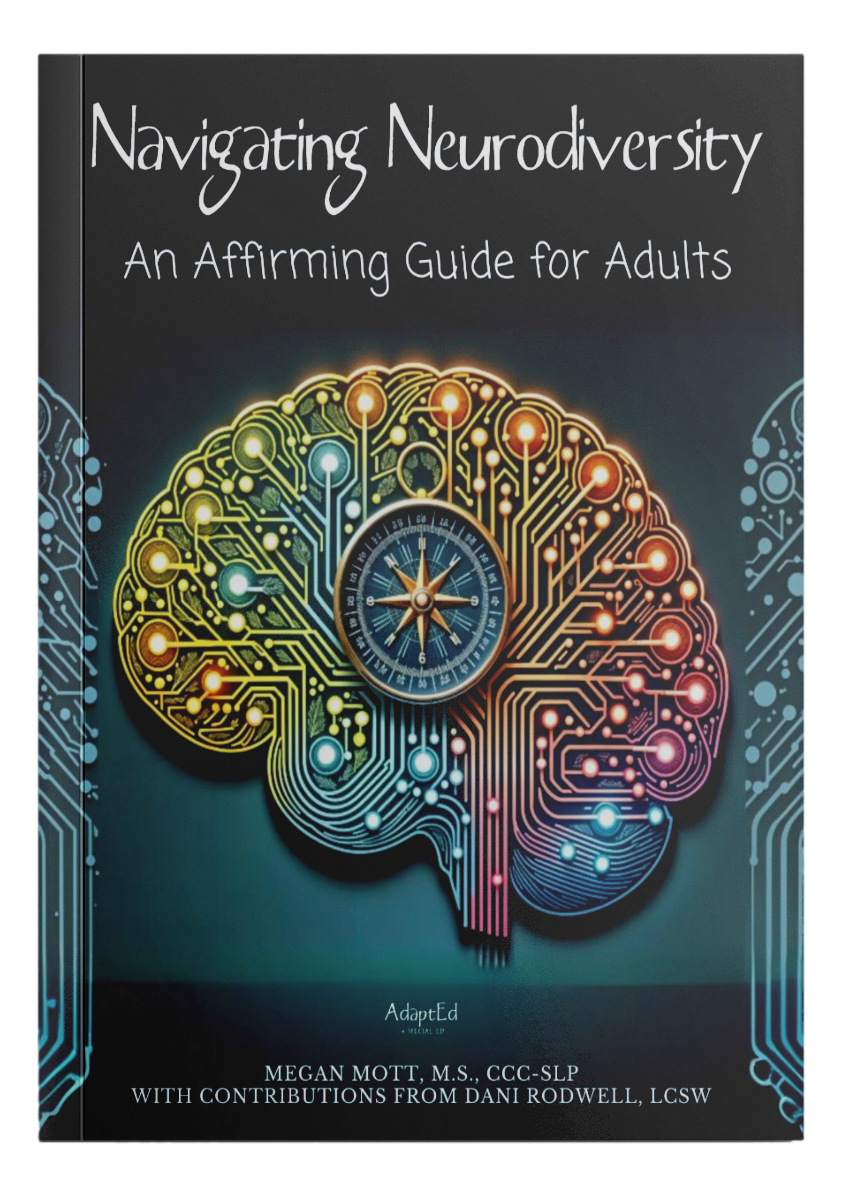

Navigating Neurodiversity: A Practical Guide for Neurodivergent Adults
For Years, You Didn't Have a Word for It. Now You Do.
"I'm often daunted by reading about this topic, so I avoid it. This was presented in a way that did not overwhelm me at all. Concise and useful."— Ami C., verified buyer
This is the guide for everything that comes next.
Navigating Neurodiversity is a practical, field-tested handbook for the late-diagnosed adult—178 pages covering everything from diagnosis to daily life, written by someone who has lived it.
✨ What's Inside
Diagnosis & identification → ADHD, autism, late-identified neurodivergence, and the many paths to self-discovery.
Masking → what it is, what it costs, and how to start unmasking on your own terms.
Executive functioning & sensory → ND profiles, regulation, stimming, and the real reasons "just try harder" never worked.
Communication & relationships → the Double Empathy Problem, ND/NT dynamics, and scripts for being understood.
Workplace & daily life → ADA accommodations, ND job strengths, finances, healthcare, and the things nobody warned you about.
ND challenges → dysregulation, RSD, PDA, and self-injurious behaviors—addressed honestly.
Finding affirming care → choosing a therapist, mental health considerations, and what non-affirming care looks like.
👤 Who It's For
This is for the adult who got their diagnosis at 32, or 47, or 58—or who is starting to recognize themselves in what their child or client is going through.
It's for the person who spent decades being told they were lazy, sensitive, dramatic, or just trying harder than everyone else seemed to need to.
It's also useful for the educational therapist, the partner, or the friend who wants to understand what their client or loved one is actually navigating.
A note on what this book isn't: it's not a guide for adults with significant support needs, and it's not a parenting resource. It's for the person who made it into adulthood by adapting—and is ready to stop doing that alone.
✍️ Written by Someone Who Lives It
Megan is a late-diagnosed SLP and mom to three neurodivergent kids. Her bestselling children's handbook has sold 25,000+ copies—this is the adult companion. 178 pages drawing on lived experience, clinical practice, and the work of leading neurodiversity-affirming voices.
📦 Choose Your Format
Digital PDF → instant access, searchable, start tonight
Paperback → tactile, durable, lays open on your desk for daily reference
Bundle (Best Value) → both formats, save when you get them together 🎉
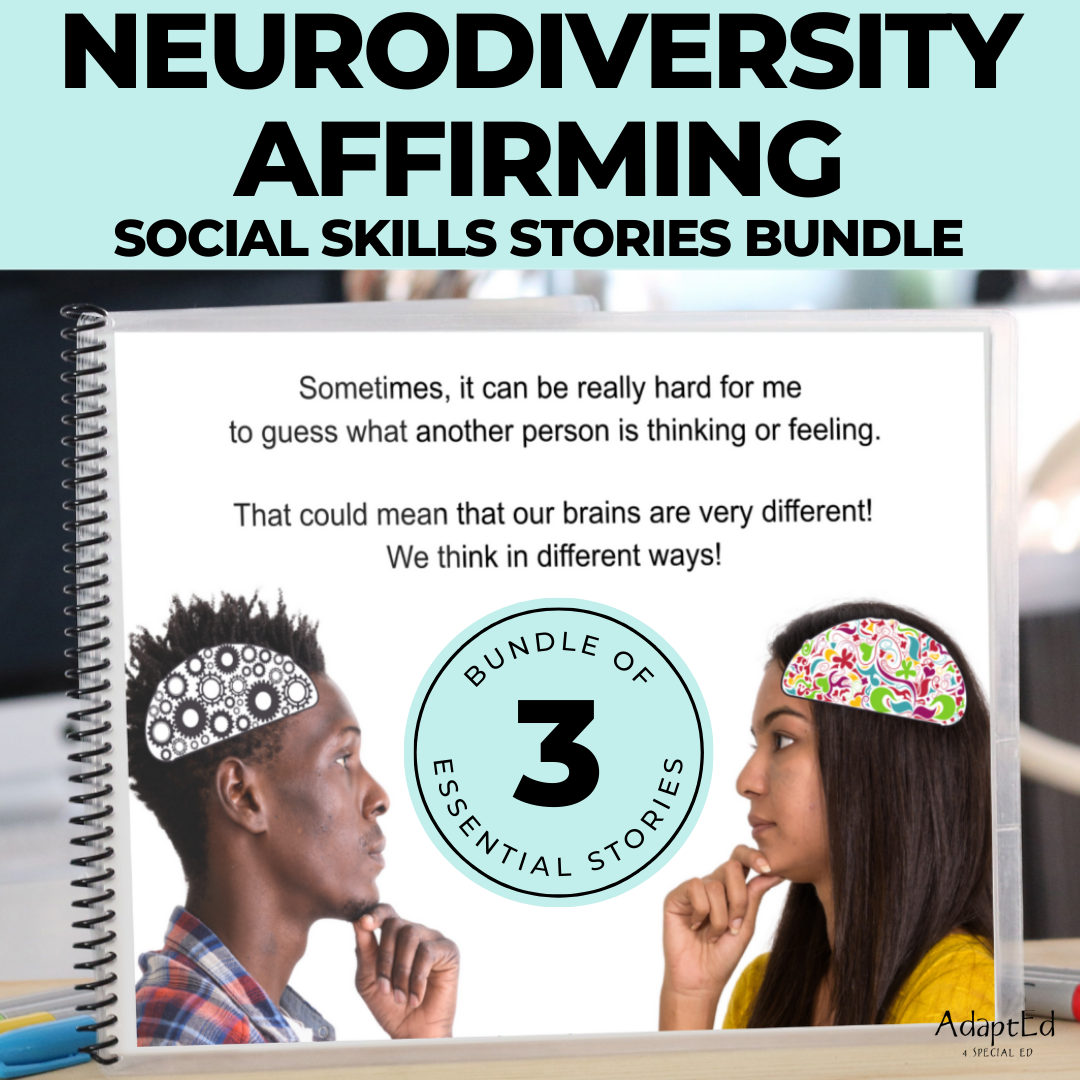
Neurodiversity-Affirming Social Stories | A Paired-Perspective Bundle for Kids
Introduce your child or students to essential social narratives in an affirming, respectful manner that acknowledges and celebrates neurodiversity. This specially curated bundle includes topics on:
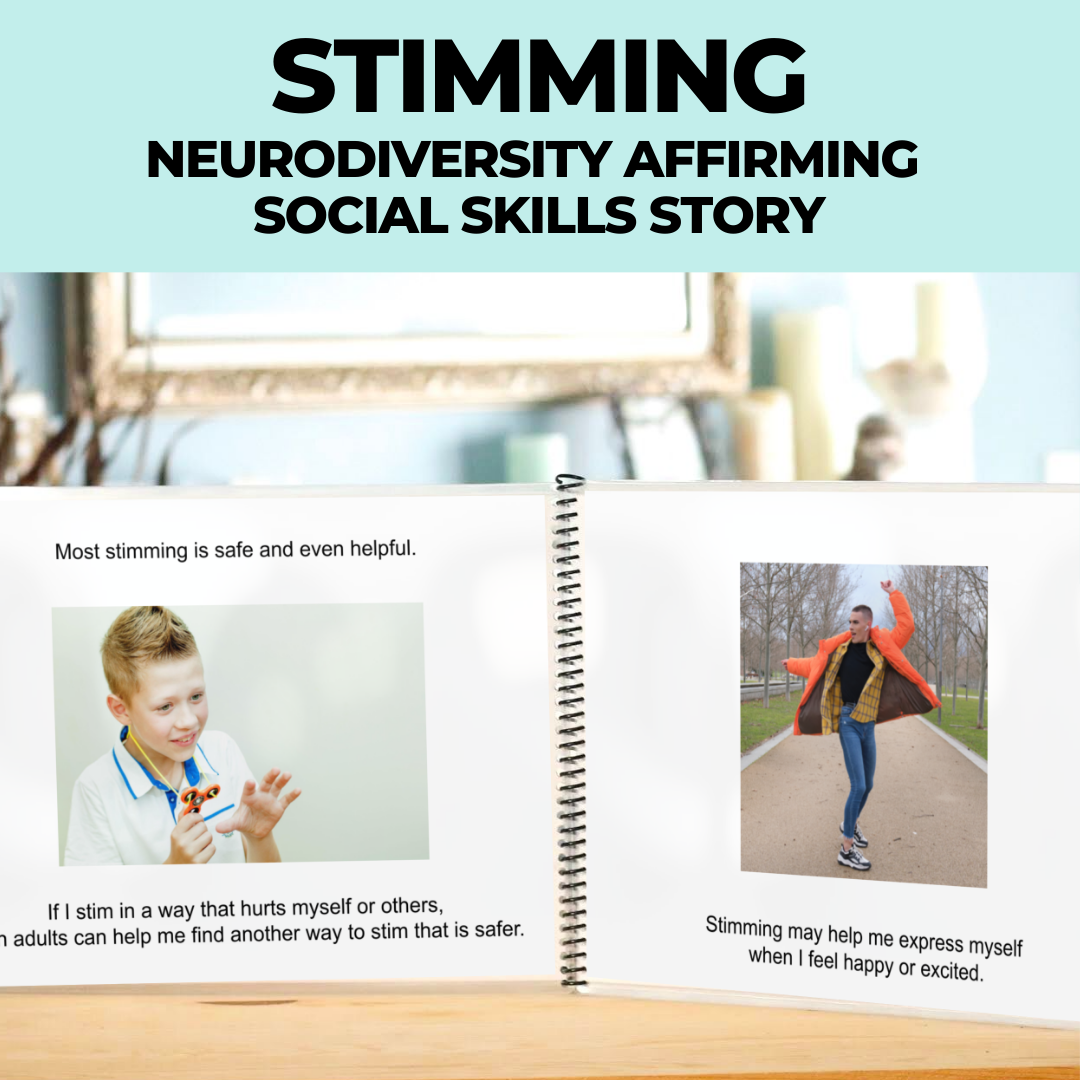
I Stim & Stimming Feels Good: These narratives are a vibrant celebration of stimming. Through these pages, we unfold the joy and necessity of stimming, inviting neurotypical peers to step into a world where stimming is understood as a positive and essential aspect of being.
I Stim: An 11-page journey that honors the beauty and validity of stimming.
Stimming Feels Good: A 12-page exploration designed for neurotypical peers to discover the joyous world of stimming, promoting acceptance and understanding.
Empathetic Perspective Taking: Spanning 14 pages, this story revolutionizes the concept of perspective-taking.
No longer a one-way street, we champion a world where understanding is a shared dance, encouraging everyone to participate in mutual empathy and connection.
Perseveration, Celebrated:
For neurodivergent learners, a 16-page tribute to the deep, passionate interests that fuel them, offering insights into navigating the social world with confidence.
A 13-page guide for neurotypical peers, inviting them to marvel at the intense passions of neurodivergent friends, recognizing these focused interests as a profound form of intelligence.
Special Features:
Edit with Ease on Google Slides: Personalize your narratives, making every story resonate even more deeply with its readers by adding names or changing visuals.
Your Choice of Format: Whether you prefer the tactile feel of a printed book or the convenience of digital access, these stories adapt to fit your world.
This bundle isn’t just a collection of stories; it’s an invitation to walk a path of inclusion, empathy, and celebration. Perfect for families, educators, and therapists, it stands as a powerful tool in advocating for a world where every neurodivergent trait is not just accepted but embraced with joy.
Step into a future where diversity is not just recognized but cherished with our Empowering Neurodiversity Bundle.
Neurodiversity Affirming Training Handbook
Real Tools for Supporting Neurodivergent Learners—Every Day
Use-now strategies for home, school, and therapy—no fluff.
102 pages · PDF or Print · Built by neurodivergent professionals
✅ What’s Inside
102-page handbook packed with ready-to-use tools
Behavior, communication (including gestalt language strategies), sensory, and IEP strategies that work in real moments
Team collaboration guides for therapists, educators, and families
Visuals, checklists, and templates you can use today
💡 Built for how you work
Flip straight to what you need and act in the moment. This won’t live on a shelf—it’ll live on your desk.
👥 Who It’s For
Educators · Therapists · Parents · Support Staff
⭐ What Educators Say
“Exactly what I was looking for. It’s laid out clearly, framed in a strength-based way, and easy to share with teams or post in the classroom. I especially appreciated the reframing of how we speak about neurodivergent students. So thankful for this resource.”— Deborah Edgett, Educator
🛒 Choose Your Format
PDF Only — Download & print what you need
Print Only — Softcover shipped to you
Both (Most Popular) — Print book + instant PDF access
Why it’s different
Free downloads are everywhere—but they cost time, energy, and second-guessing. This handbook saves hours with 100+ pages of practical, field-tested strategies—created by neurodivergent professionals and veteran special educators.
Inclusive by design
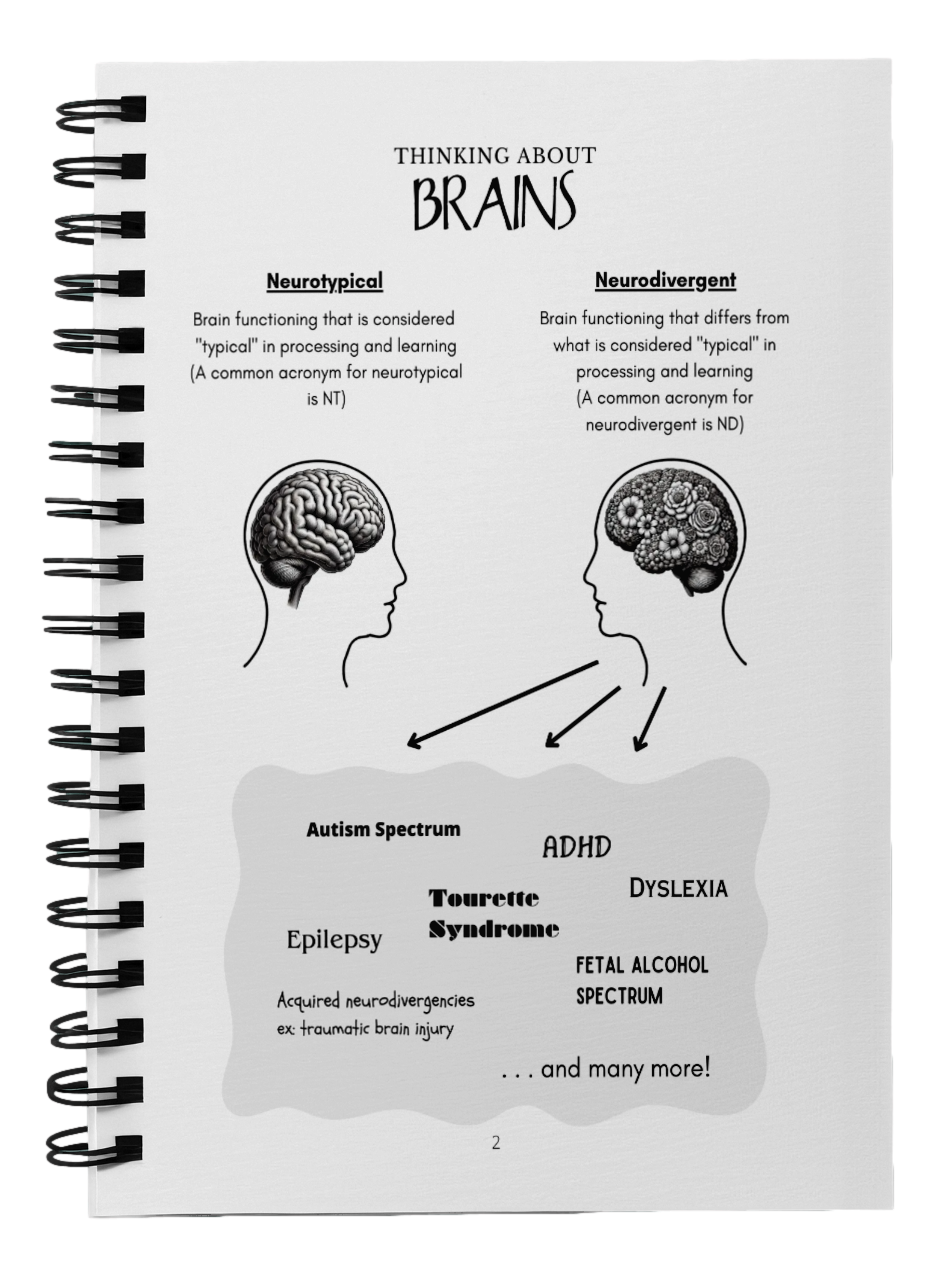
Supports learners with Autism, ADHD, Dyslexia, Dyspraxia, Tourette Syndrome, Fetal Alcohol Spectrum Disorder (FASD), sensory processing differences, and other learning and attention profiles.
Get started
Support neurodivergent learners with clarity, confidence, and care.
POs welcome · 1-business-day email support · Instant downloadEmail: service@adapted4specialed.com
00
DAYS 00
HRS 00
MIN 00
SEC
DAYS 00
HRS 00
MIN 00
SEC
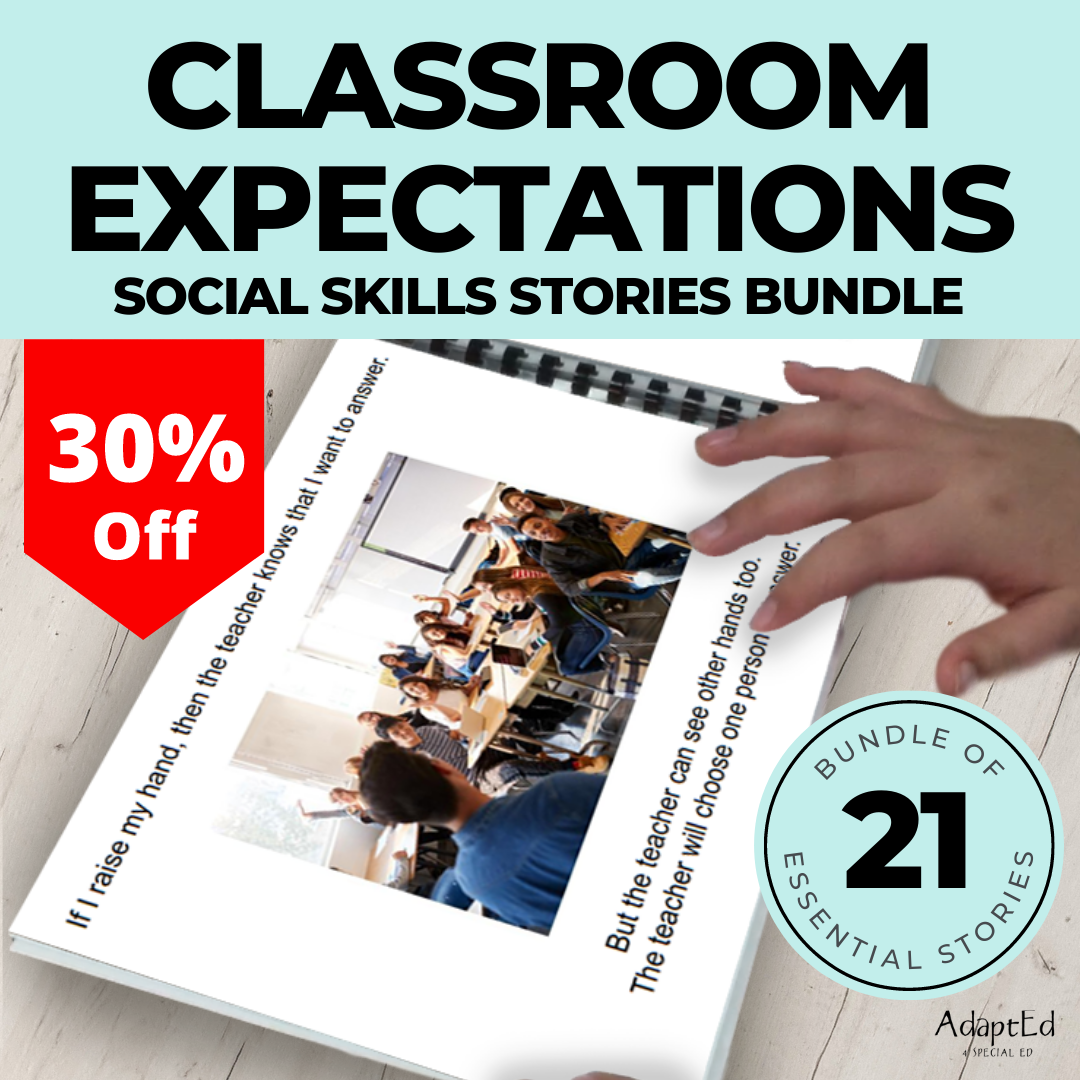
Social Skills Stories: Classroom Expectations Bundle: Editable
Looking for a fun and engaging way to help adolescents learn classroom expectations? Look no further than the Classroom Expectations Social Skills Story Bundle!
This bundle of stories is specifically designed to help adolescents navigate social skills, written by SLPs in clear and concise language, accompanied by helpful visuals.
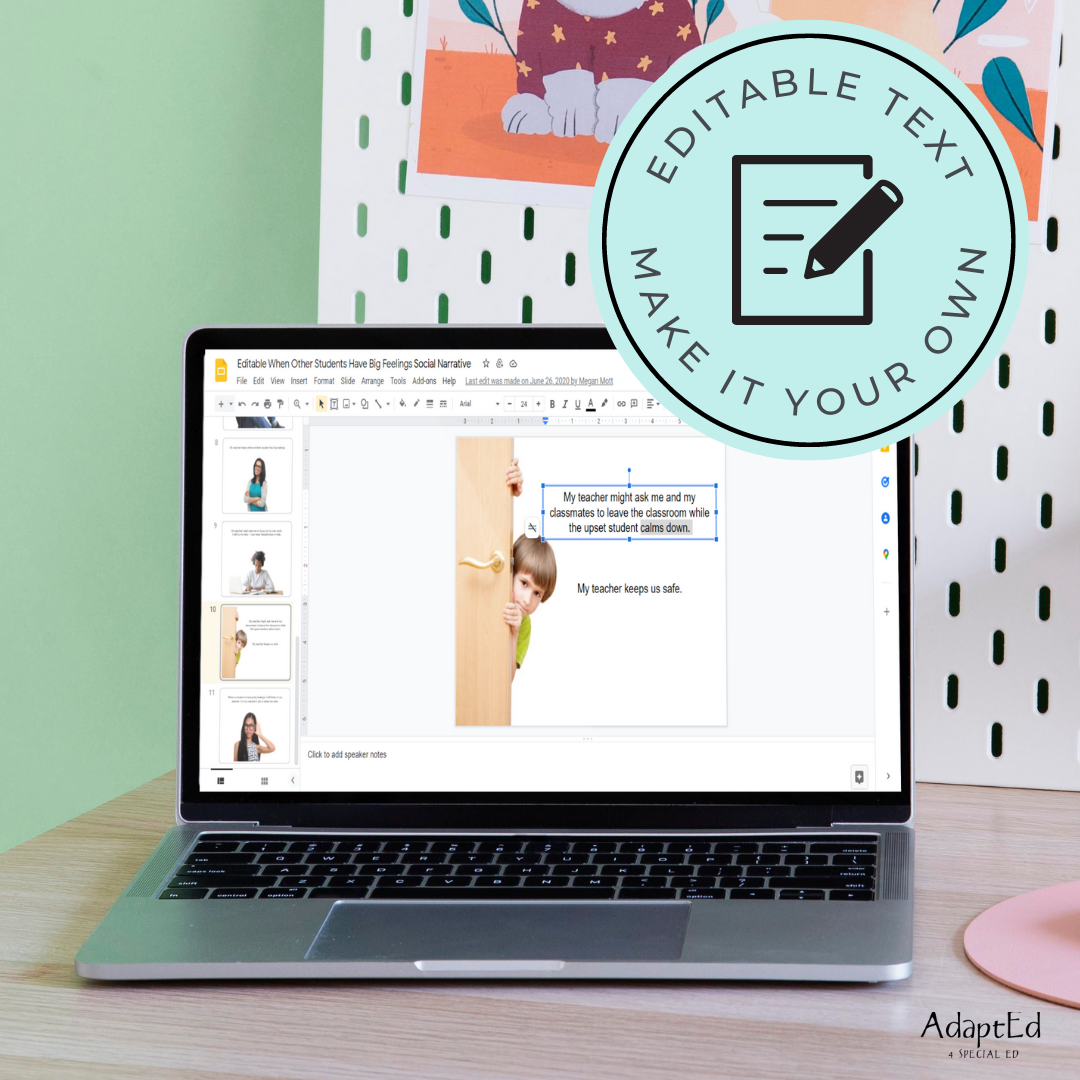
Plus, all stories are editable so you can change them to address each adolescent's unique needs. So why wait? Get your Classroom Expectations Social Skills Story Bundle today!
School Expectation Social Stories
Keeping My Clothes On at School
Keeping My Shoes On at School
Listening
Controlling My Volume
Elopement / Running Away
Personal Space
Silly vs. Serious
Accepting Feedback
Back to Class/ Joining My Class
Not Answering for Others
Classroom Conversations (think, pair, share)
Watching Videos at School
Wearing my Glasses
Finishing My Work
When I don't Get to Answer
When Other Students Have Big Feelings
I'm Responsible for My Things
Using My Phone at School
Taking my Time with my Work
Respecting School Property
When Time is Up: Transitioning to the Next Thing


00
DAYS 00
HRS 00
MIN 00
SEC
DAYS 00
HRS 00
MIN 00
SEC
Social Skills Stories: School Expectations Bundle: Editable
Making the transition to school can be tough for any adolescent. They suddenly have to juggle a lot of different expectations and social cues. That's why we created the School Expectations Social Skills Story Bundle.
This bundle of stories is specifically designed to help adolescents navigate the expectations they'll come across at school. They're written by SLPs in clear and concise language, accompanied by helpful visuals. Plus, all stories are editable so you can change them to address each adolescent's unique needs.
With this bundle, you'll get: a story about each of the topics listed below...
School Expectation Social Stories:
Keeping My Clothes On at School
Keeping My Shoes On at School
Spitting
Scratching
Elopement
Biting
Pulling Hair
Recess
Riding the Bus
Wearing a Jacket
I'm in a Relationship: Having a Boyfriend/Girlfriend at School
Using My Phone at School
Respecting School Property
Scratching
Cafeteria/ Lunchroom
Where Can I Pee? Public Urination
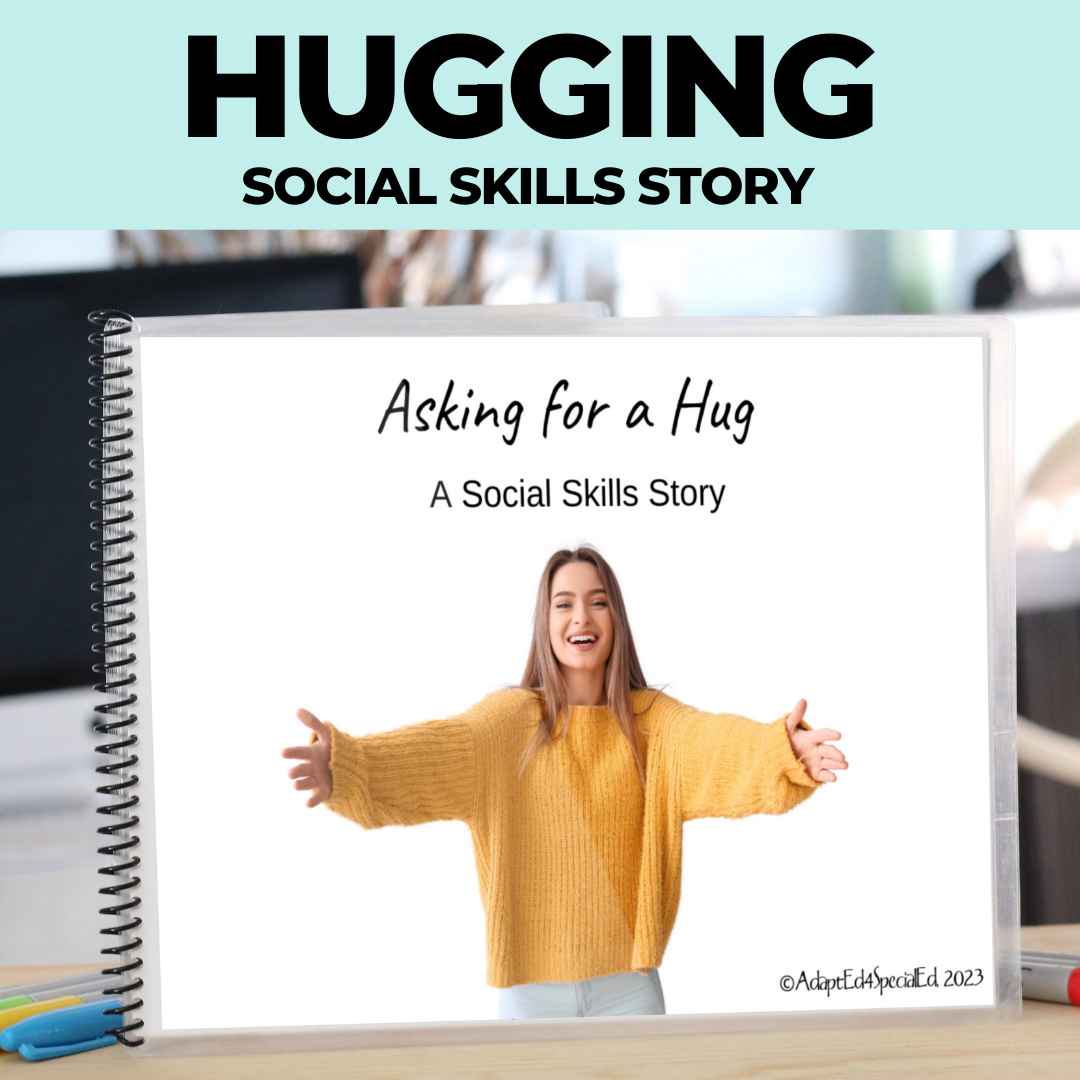
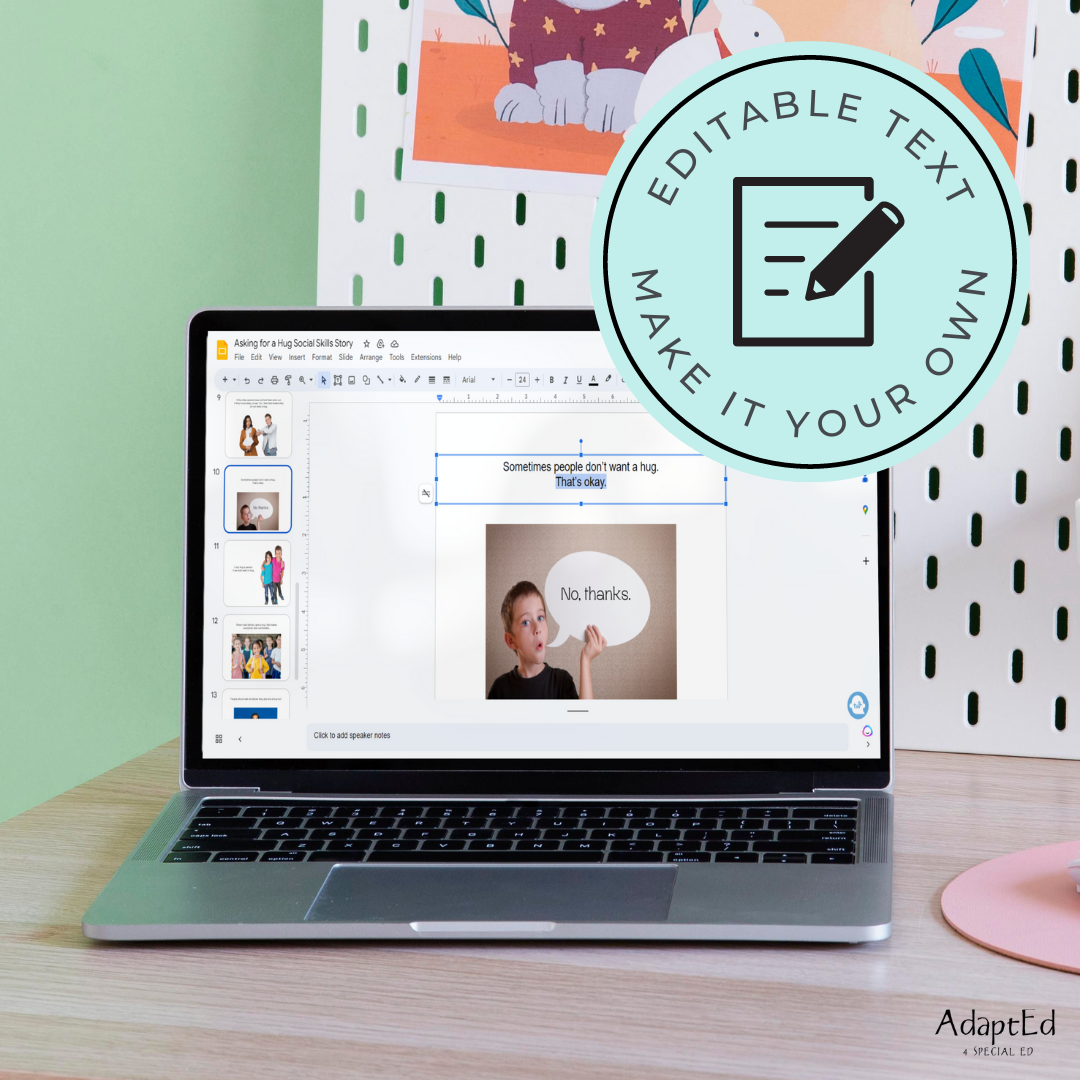
Asking for a Hug Editable Social Skills Story (Printable PDF )
Our social story on asking permission for hugs is the perfect educational tool for special educators and parents of neurodivergent children. With our easy to understand text and real photographs, young people can learn:
The importance of seeking permission prior to physical contact in a safe space
How to read non-verbal cues, such as when someone reaches their arms out for a hug more effectively
To foster an atmosphere where individual differences are accepted
Tailored intervention strategies to teach kids about consent
Included:
13 page social skills story
Print and bind into a book, or just read it digitally on any of your devices.
Editable Version Saved on Google Slides
Print and bind into a book, or just read it digitally on any of your devices.
Want to edit this book?
Possibly add in a student name or change a picture? 📷
You can do that now! Just click the link in the back of the book and you'll be taken to an editable version saved in google slides! 💻
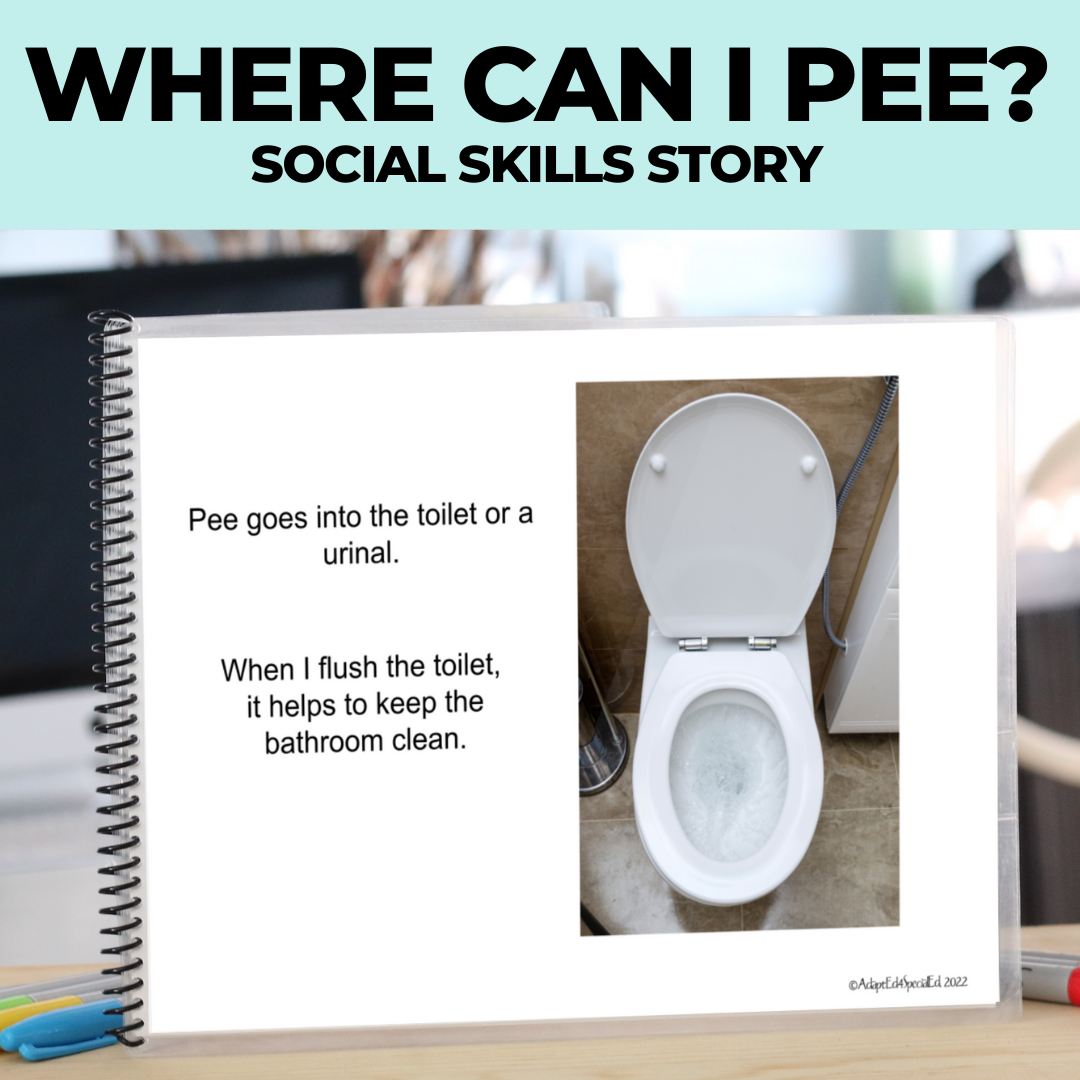
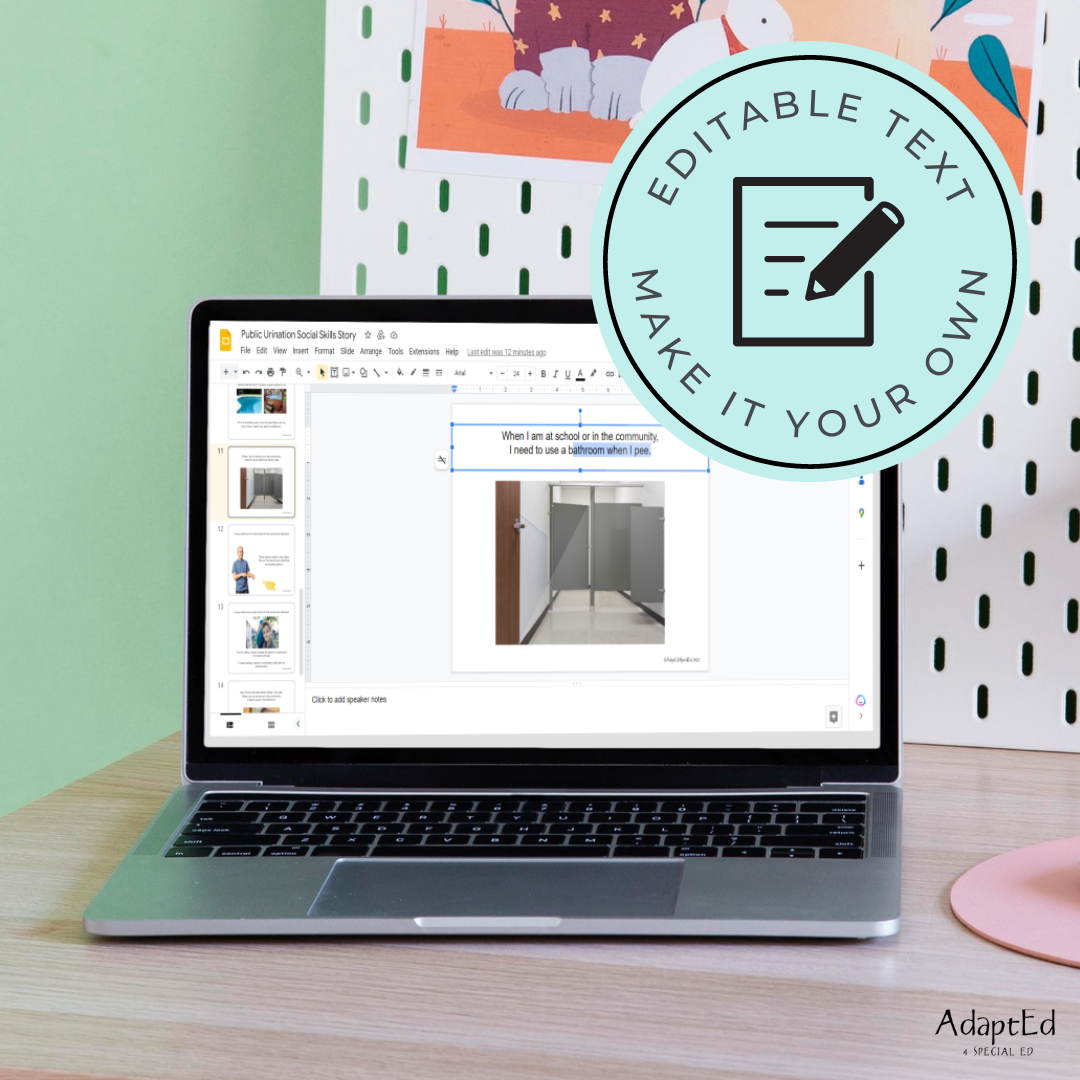
Social Skills Story: Where Can I Pee? Public Urination: Editable (Printable PDF )
Introducing Where Can I Pee?, the Social Skills Story that provides clear direction for children on proper restroom usage and etiquette. With 11 pages of engaging, easy-to-read information about when it’s okay to urinate outside and when it’s not, this unique product is the perfect tool for helping kids learn about appropriate behavioral expectations so that everyone can enjoy a clean, safe, and private environment.
Where Can I Pee? offers explicit detail about which public locations require restroom use; school grounds and community areas are discussed, while outings to nature or camping sites all provide different protocols. The story stresses the importance of keeping places clean and hygienic in order to maintain safety measures, as well as the need to keep one’s genitals private.
With its professional yet confident tone written especially for kids, they’ll be better equipped with the knowledge they need to make smart decisions and have healthy interactions with those around them!
11 Page Social Skills Story
Editable Text
Print and bind into a book, or just read it digitally on any of your devices.
P.S. If you like this book, you may be interested in checking out our full collection of bathroom related social narratives.
Editable
Want to edit this book?
Possibly add in a student name or change a picture? 📷
You can do that now! Just click the link in the back of the book and you'll be taken to an editable version saved in google slides! 💻
