
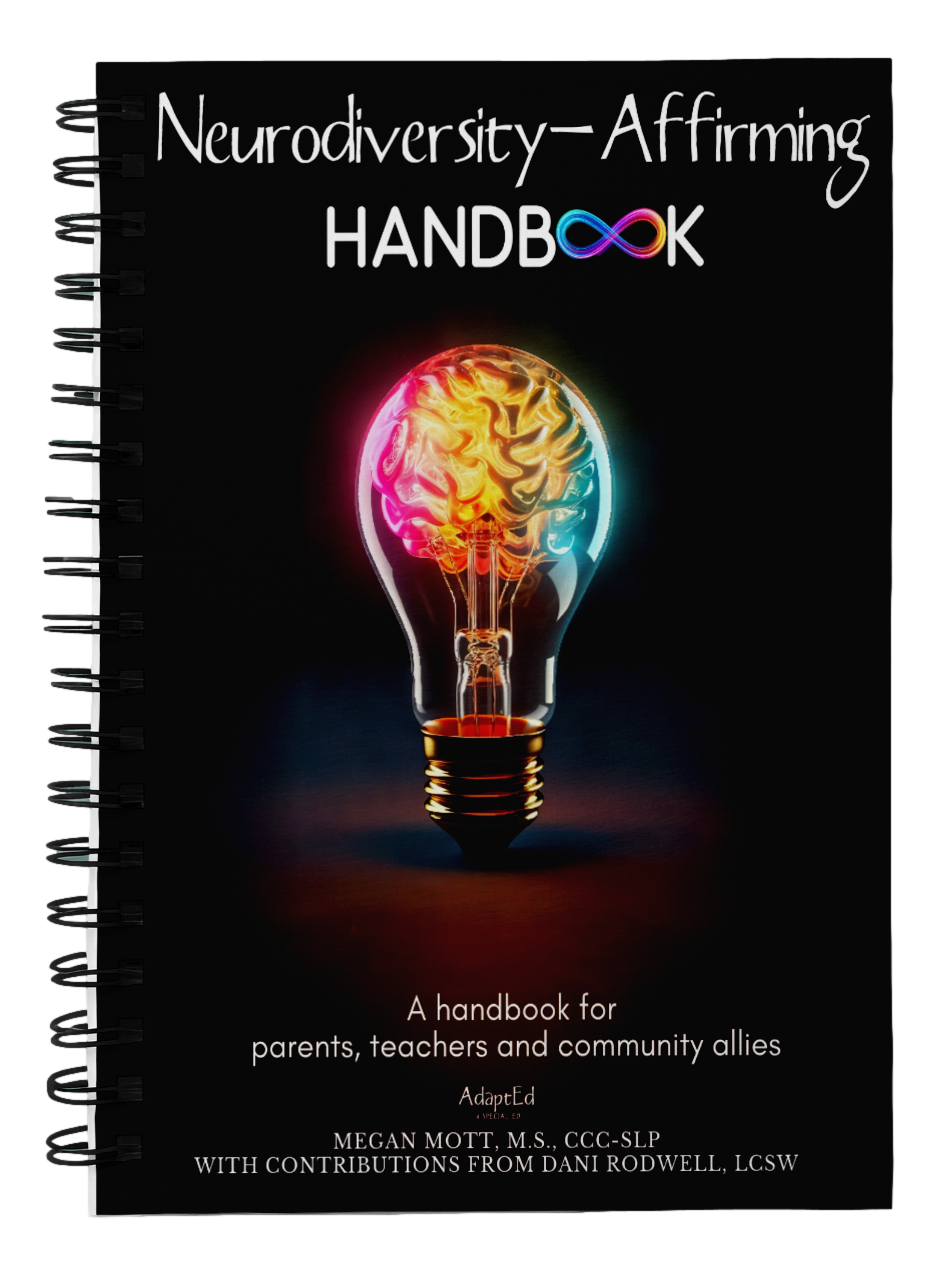
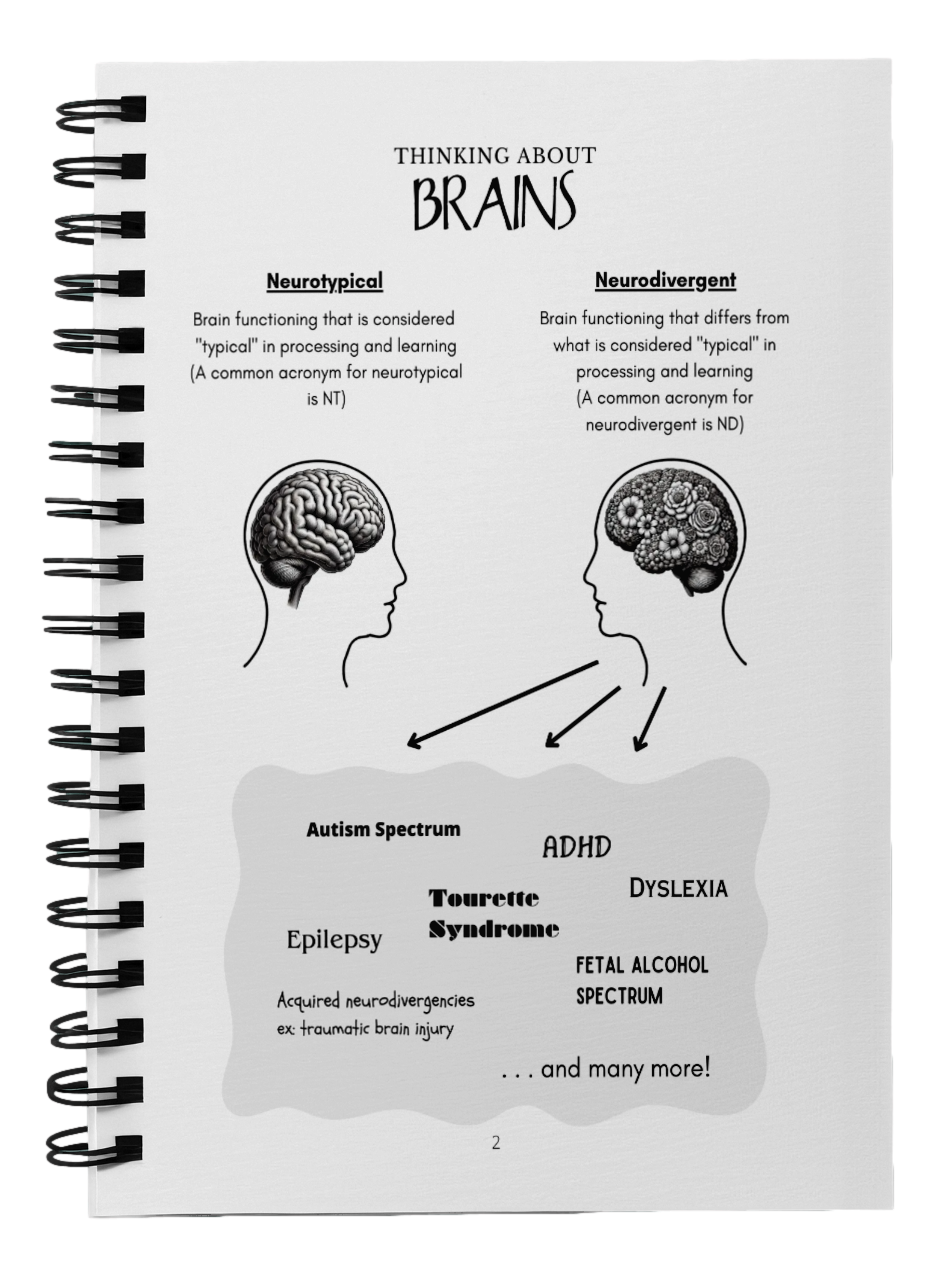
Neurodiversity Affirming Training Handbook
Real Tools for Supporting Neurodivergent Learners—Every Day
Use-now strategies for home, school, and therapy—no fluff.
102 pages · PDF or Print · Built by neurodivergent professionals
✅ What’s Inside
102-page handbook packed with ready-to-use tools
Behavior, communication (including gestalt language strategies), sensory, and IEP strategies that work in real moments
Team collaboration guides for therapists, educators, and families
Visuals, checklists, and templates you can use today
💡 Built for how you work
Flip straight to what you need and act in the moment. This won’t live on a shelf—it’ll live on your desk.
👥 Who It’s For
Educators · Therapists · Parents · Support Staff
⭐ What Educators Say
“Exactly what I was looking for. It’s laid out clearly, framed in a strength-based way, and easy to share with teams or post in the classroom. I especially appreciated the reframing of how we speak about neurodivergent students. So thankful for this resource.”— Deborah Edgett, Educator
🛒 Choose Your Format
PDF Only — Download & print what you need
Print Only — Softcover shipped to you
Both (Most Popular) — Print book + instant PDF access
Why it’s different
Free downloads are everywhere—but they cost time, energy, and second-guessing. This handbook saves hours with 100+ pages of practical, field-tested strategies—created by neurodivergent professionals and veteran special educators.
Inclusive by design
Supports learners with Autism, ADHD, Dyslexia, Dyspraxia, Tourette Syndrome, Fetal Alcohol Spectrum Disorder (FASD), sensory processing differences, and other learning and attention profiles.
Get started
Support neurodivergent learners with clarity, confidence, and care.
POs welcome · 1-business-day email support · Instant downloadEmail: service@adapted4specialed.com
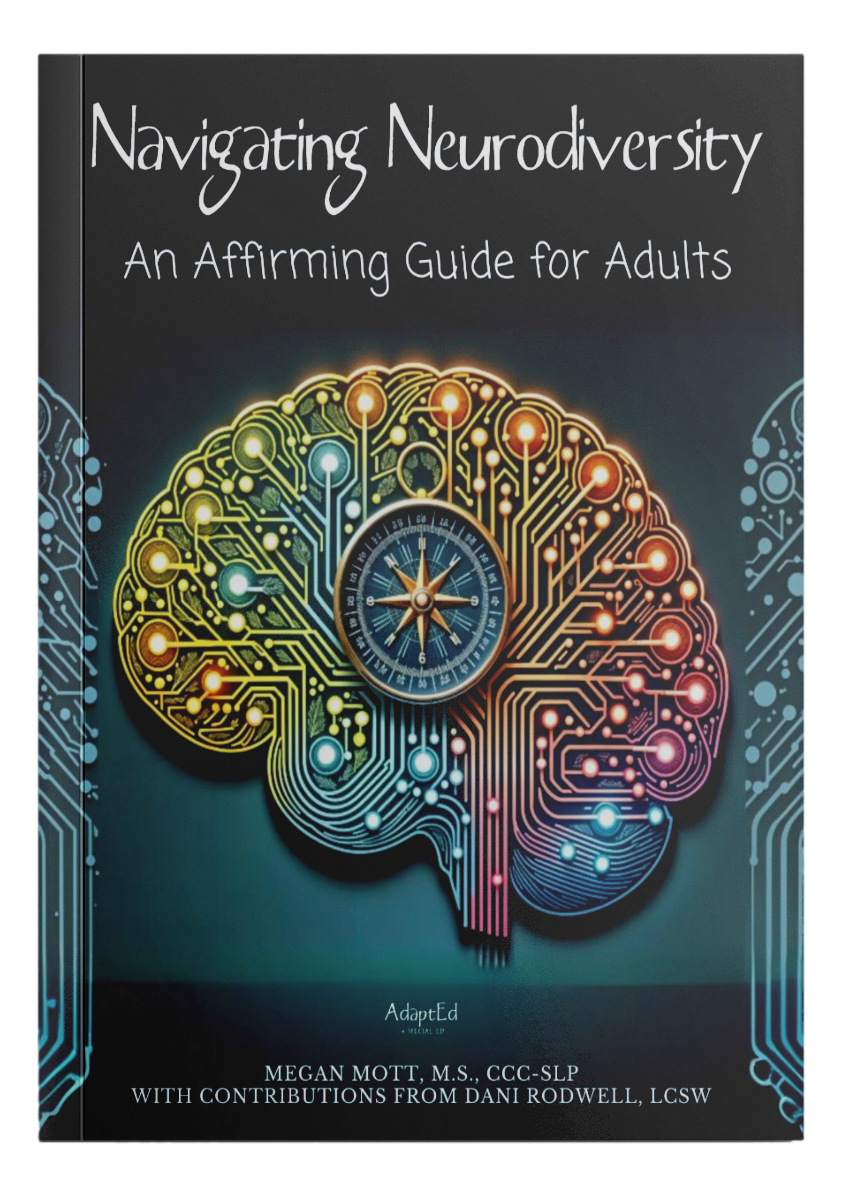

Navigating Neurodiversity: A Practical Guide for Neurodivergent Adults
For Years, You Didn't Have a Word for It. Now You Do.
"I'm often daunted by reading about this topic, so I avoid it. This was presented in a way that did not overwhelm me at all. Concise and useful."— Ami C., verified buyer
This is the guide for everything that comes next.
Navigating Neurodiversity is a practical, field-tested handbook for the late-diagnosed adult—178 pages covering everything from diagnosis to daily life, written by someone who has lived it.
✨ What's Inside
Diagnosis & identification → ADHD, autism, late-identified neurodivergence, and the many paths to self-discovery.
Masking → what it is, what it costs, and how to start unmasking on your own terms.
Executive functioning & sensory → ND profiles, regulation, stimming, and the real reasons "just try harder" never worked.
Communication & relationships → the Double Empathy Problem, ND/NT dynamics, and scripts for being understood.
Workplace & daily life → ADA accommodations, ND job strengths, finances, healthcare, and the things nobody warned you about.
ND challenges → dysregulation, RSD, PDA, and self-injurious behaviors—addressed honestly.
Finding affirming care → choosing a therapist, mental health considerations, and what non-affirming care looks like.
👤 Who It's For
This is for the adult who got their diagnosis at 32, or 47, or 58—or who is starting to recognize themselves in what their child or client is going through.
It's for the person who spent decades being told they were lazy, sensitive, dramatic, or just trying harder than everyone else seemed to need to.
It's also useful for the educational therapist, the partner, or the friend who wants to understand what their client or loved one is actually navigating.
A note on what this book isn't: it's not a guide for adults with significant support needs, and it's not a parenting resource. It's for the person who made it into adulthood by adapting—and is ready to stop doing that alone.
✍️ Written by Someone Who Lives It
Megan is a late-diagnosed SLP and mom to three neurodivergent kids. Her bestselling children's handbook has sold 25,000+ copies—this is the adult companion. 178 pages drawing on lived experience, clinical practice, and the work of leading neurodiversity-affirming voices.
📦 Choose Your Format
Digital PDF → instant access, searchable, start tonight
Paperback → tactile, durable, lays open on your desk for daily reference
Bundle (Best Value) → both formats, save when you get them together 🎉


THE SLP’S GUIDE TO AAC: From Assessment to Implementation
AAC Handbook for SLPs
The SLP’s Guide to AAC: From Assessment to Implementation
AAC shouldn’t require guesswork… but most SLPs are left guessing.
Most SLPs were never taught how to complete a full AAC assessment, choose the right system, or support teams—yet the moment an AAC user lands on your caseload, you’re expected to know it all.
This handbook gives you the structure, clarity, and confidence you should have been handed on day one.
Created by Megan Mott, M.S., CCC-SLP—an experienced, neurodivergent SLP—this guide is the step-by-step reference clinicians wish they had from the start.
Complete AAC assessments with confidence
Understand how to match the right system to the right communicator
Support teams so AAC doesn’t fall apart in real classrooms
Built for real-world SLPs
What You’ll Be Able to Do with This Guide
Complete AAC assessments with a clear, repeatable process
Choose systems & features that line up with communication needs
Train teams without overwhelming them
Model AAC without pressure or unrealistic expectations
Support emergent & conventional literacy for AAC users
Document clearly for IEPs, schools, and insurance
Stop guessing—and start leading AAC teams
Why This Handbook Is Different
This guide doesn’t just talk about AAC—it walks you through the entire process with clear visuals, examples, and real-world guidance.
Move from “I’m not sure what to do next” to “I know exactly how to approach this communicator, this team, and this setting.”
Table of Contents (What’s Inside)
Here’s a readable look at what’s inside the handbook:
Chapter 1: AAC Fundamentals
Who Uses AAC?
Types of AAC
Types of AAC Access
Types of AAC Tools
Chapter 2: AAC Core Values
Different, Not Less
Autonomy
AAC Myths and Truths
Chapter 3: AAC Modeling & Practices
Types of Vocabulary
What Is Motor Planning?
What Is Modeling?
Model Without Expectation
Attribute Meaning
Validate All Communication
Reasons People Communicate
Necessary AAC Strategies
Practices to Avoid
Chapter 4: AAC Competencies
Ask Yourself
Chapter 5: AAC Classroom Tips & Ideas
Communicating for a Variety of Purposes
Chapter 6: AAC & Literacy
An Expanded View of Literacy
Determining the Level of Instruction
Emergent Literacy Instruction
Conventional Literacy Instruction
Assistive Technology & Literacy
Chapter 7: AAC Assessment
Feature Matching: Access Method
Feature Matching: Symbol Features
Feature Matching: Linguistic Features & Vocabulary
Feature Matching: Voice Features
Feature Matching: Display Features
Feature Matching: Positioning & Portability
Feature Matching: Additional Features
AAC Funding Overview
The Assessment Process
Part 1: Gather a Case History
Part 2: AAC Trials
Part 3: Device Recommendations & Documentation
Chapter 8: Appendix
How Big Is the Problem for Me?
Play Activities
AAC Data Sheets
AAC Modeling & Implementation
Learn what implementation looks like when it’s ethical, effective, and doable for busy teams.
Model AAC without expectation or pressure
Introduce AAC in supportive, safe ways
Problem-solve when teams aren’t modeling
Validate all communication—not just words
Avoid common AAC pitfalls (and understand why they matter)
AAC & Literacy
Find practical routines for emergent and conventional literacy—paired with assistive technology supports that make sense in real classrooms.
Tools & Templates Included
Data sheets for all AAC competencies
Device trial templates
Team-training reminders
Lesson ideas
Quick-reference charts
Checklists & guides
Documentation supports
Format Options
Choose the Format That Fits Your Workflow
Physical handbook – premium soft-touch cover, premium paper, and durable metal binding.
Digital PDF – searchable, portable, and ideal for team meetings.
Bundle: Physical + Digital – get both formats for maximum flexibility.
Use the format that makes it easiest to build AAC systems that actually work.
AAC doesn’t have to feel overwhelming or improvised.
The SLP’s Guide to AAC: From Assessment to Implementation gives you the clarity, structure, and confidence every SLP deserves—so you can stop guessing and start leading.


AAC Core Word Builder Set 1 | 20 Weeks of No-Prep Speech Therapy Lessons for SLPs
Just 80 words make up about half of everyday English. This curriculum teaches the first ones that matter most.
AAC Core Word Builder: Set 1 is the first 20 weeks of a structured, year-long curriculum designed to teach foundational core vocabulary systematically — turning isolated words into real, generalized communication.
Created by Meg Mott, M.S., CCC-SLP, AdaptEd's resident AAC specialist and parent of an autistic son. Originally built for teletherapy in 2020 and refined across years of real classroom and clinic use, this curriculum is now trusted by SLPs, special educators, and AAC teams across the country.
Set 1 covers 17 high-frequency core words across 20 weeks — including extended two-week instruction for Go, Turn, and Not/Don't because high-utility words deserve deeper repetition.
What this curriculum gives you
20 weeks of ready-to-use AAC lessons — no prep beyond opening the file
A consistent weekly structure across all 20 lessons, so students know what to expect
Multi-modal activities that engage attention, body, and family — not just the screen
Generalization built in through parent handouts and homework that extend learning beyond the session
A clear progression from first words to functional communication across settings
Who this is for
SLPs looking for structured, evidence-aligned AAC instruction without spending Sunday nights building lessons from scratch
Special education teachers supporting students with complex communication needs who want a curriculum they can actually run
Teletherapy and hybrid clinicians who need engaging, screen-friendly materials that hold attention across digital sessions
AAC teams looking for shared lesson materials that align across providers, classrooms, and home
Parents wanting to extend AAC learning at home with structured guidance, not just generic suggestions
What's inside each weekly lesson
Each of the 20 weeks centers on one core word, taught through seven coordinated activities:
Introductory GameA low-pressure activity individually crafted for each lesson, designed to introduce the target word without performance pressure.
Animated E-BookReal photographs arranged into a unique book for each word — minimum 10 pages, with movement on every page to hold attention and reinforce the word in context.
Movement BreakA targeted movement activity tied to the target word — from a simple linked dance video to a custom movement game — that builds regulation into the lesson.
Additional ActivityAn extra engagement that may center on a song, a video, a book extension, or a guided drawing, giving you variation across the week.
Parent HandoutA take-home guide for every word, so families have direction for practicing core vocabulary at home and learning generalizes across settings.
HomeworkA simple homework activity, easily shared electronically — including a flexible "book report" format that works any week of the curriculum.
The 17 core words you'll teach in Set 1
These are the words that unlock the most communication for the least effort. Three of them — Go, Turn, and Not/Don't — get a second week of instruction because their utility justifies the deeper practice.
Go (2 weeks)
Turn (2 weeks)
Not/Don't (2 weeks)
Eat
Come
Put
Help
Like
Open
Want
All Done
More
What?
I/You
On
Off
Drink
Continue the curriculum with Set 2 and Set 3
Set 1 is the foundation. The full curriculum continues with another 40 weeks of core vocabulary across two additional sets:
Set 2 — 20 more weeks featuring Stop, Look, Up, Good, Make, Work, In, Read, Take, and more.
Set 3 — 20 final weeks featuring Big, Where, Feel, Give, Fast, Slow, Ready, Away, and more.
Buy each set individually as you progress through the year, or save $30 with the Complete Curriculum Bundle (Sets 1–3, 60 weeks of lessons).
Formats, delivery & purchase orders
💻 Digital download — instant access after purchase
📱 Works on iPad, laptop, Chromebook, or any device with internet access
🎓 Compatible with teletherapy, push-in, pull-out, and home use
Purchase orders accepted. Email service@adapted4specialed.com


AAC Core Word Builder Set 2 | 20 Weeks of No-Prep Speech Therapy Lessons for SLPs
Just 80 words make up about half of everyday English. Set 2 takes students from foundation to fluency.
AAC Core Word Builder: Set 2 is the second 20 weeks of a structured, year-long curriculum—building on Set 1's foundation with vocabulary that introduces regulation, evaluation, and richer interaction. From Stop and Look to Happy and Different, these are the words that move students from basic requesting to genuine conversation.
Created by Meg Mott, M.S., CCC-SLP, AdaptEd's resident AAC specialist and parent of an autistic son. Originally built for teletherapy in 2020 and refined across years of real classroom and clinic use, this curriculum is now trusted by SLPs, special educators, and AAC teams across the country.
Set 2 covers 20 high-frequency core words across 20 weeks—each taught through seven coordinated activities designed to build fluency, regulation, and generalization.
What this curriculum gives you
20 weeks of ready-to-use AAC lessons—no prep beyond opening the file
A consistent weekly structure across all 20 lessons, so students know what to expect
Vocabulary that builds on Set 1's foundation with regulatory, evaluative, and emotional core words
Multi-modal activities that engage attention, body, and family—not just the screen
Generalization built in through parent handouts and homework that extend learning beyond the session
Who this is for
SLPs looking for structured, evidence-aligned AAC instruction without spending Sunday nights building lessons from scratch
Special education teachers supporting students with complex communication needs who want a curriculum they can actually run
Teletherapy and hybrid clinicians who need engaging, screen-friendly materials that hold attention across digital sessions
AAC teams looking for shared lesson materials that align across providers, classrooms, and home
Parents wanting to extend AAC learning at home with structured guidance, not generic suggestions
What's inside each weekly lesson
Each of the 20 weeks centers on one core word, taught through seven coordinated activities:
Introductory GameA low-pressure activity individually crafted for each lesson, designed to introduce the target word without performance pressure.
Animated E-BookReal photographs arranged into a unique book for each word—minimum 10 pages, with movement on every page to hold attention and reinforce the word in context.
Movement BreakA targeted movement activity tied to the target word—from a simple linked dance video to a custom movement game—that builds regulation into the lesson.
Additional ActivityAn extra engagement that may center on a song, a video, a book extension, or a guided drawing, giving you variation across the week.
Parent HandoutA take-home guide for every word, so families have direction for practicing core vocabulary at home and learning generalizes across settings.
HomeworkA simple homework activity, easily shared electronically—including a flexible "book report" format that works any week of the curriculum.
The 20 core words you'll teach in Set 2
Set 2's vocabulary builds on Set 1's foundation, introducing the words that move students from basic requesting to richer, more nuanced communication—regulation words like Stop and Wait, evaluation words like Good and Bad, and emotional vocabulary like Happy and Sick.
Stop
Get
Look/See
Up
Good
Make
Work
In
Who
Read
Different
Bad
Hear/Listen
Take
Do
Again
Wait
Happy
Sick
Out
Continue the curriculum with Set 1 and Set 3
Set 2 builds on the foundation laid by Set 1 and continues toward Set 3's completing vocabulary. Together, the three sets provide a full school year of structured AAC instruction.
Set 1 — Weeks 1–20The foundation: Go, Help, More, Eat, Want, and the first words students need to ask, request, and connect.
Set 3 — Weeks 41–60The completion: Big, Where, Feel, Give, Ready, and the descriptive, emotional, and forward-motion words that round out the curriculum.
Buying all three? Save $30 with the Complete Bundle (Sets 1–3, 60 weeks of lessons).
Formats, delivery & purchase orders
💻 Digital download—instant access after purchase
📱 Works on iPad, laptop, Chromebook, or any device with internet access
🎓 Compatible with teletherapy, push-in, pull-out, and home use
Purchase orders accepted. Email service@adapted4specialed.com

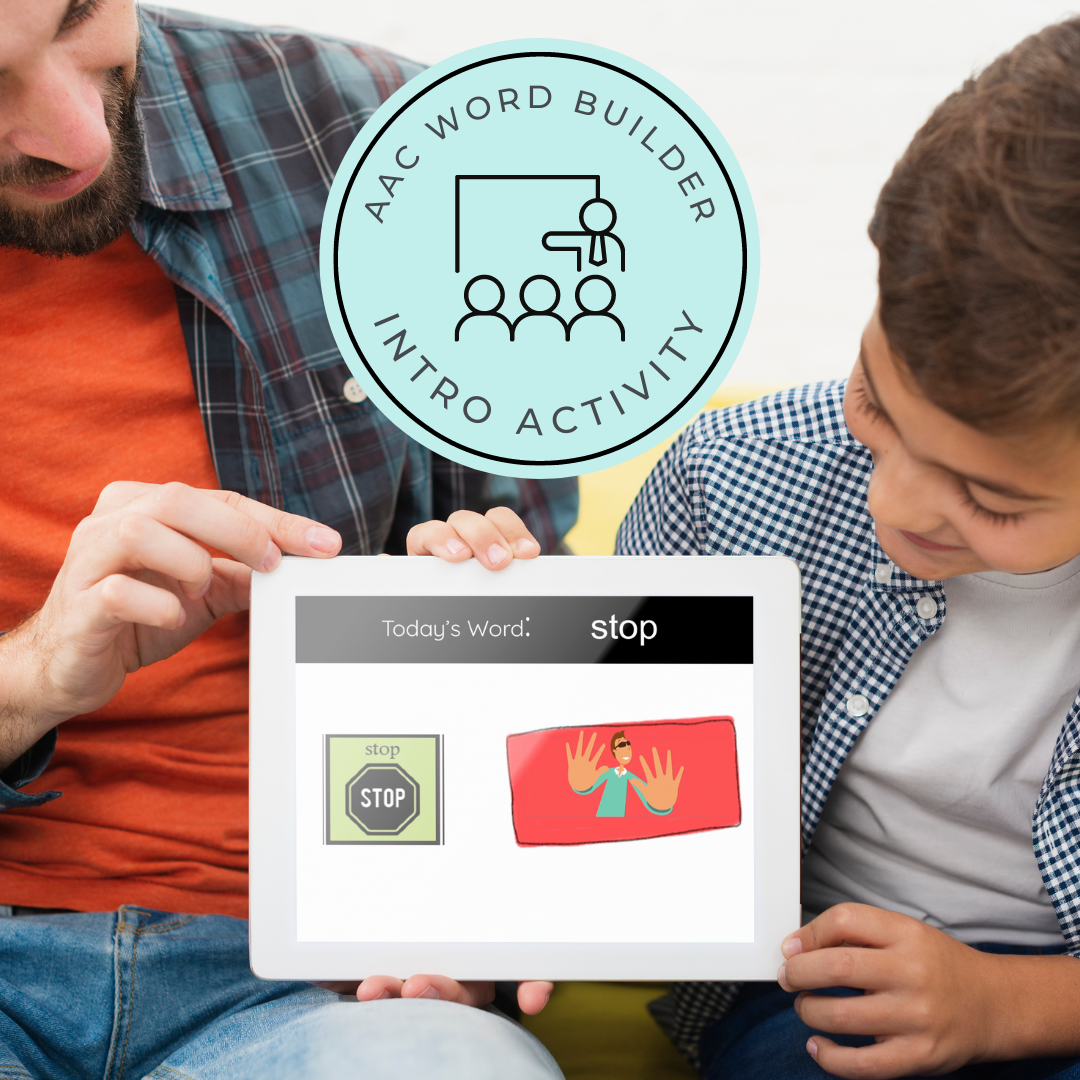
AAC Core Word Builder Set 3 | 20 Weeks of No-Prep Speech Therapy Lessons for SLPs
Just 80 words make up about half of everyday English. Set 3 completes the year with the words that make communication expressive.
AAC Core Word Builder: Set 3 is the final 20 weeks of a structured, year-long curriculum—rounding out the program with descriptive language, emotional vocabulary, and the words students need to express preferences, feelings, and observations. From Big and Little to Happy—wait, that's Set 2—from Big and Little to Sad and Silly, these are the words that turn basic communication into genuine self-expression.
Created by Meg Mott, M.S., CCC-SLP, AdaptEd's resident AAC specialist and parent of an autistic son. Originally built for teletherapy in 2020 and refined across years of real classroom and clinic use, this curriculum is now trusted by SLPs, special educators, and AAC teams across the country.
Set 3 covers 20 high-frequency core words across 20 weeks—each taught through seven coordinated activities designed to build expressive vocabulary, descriptive language, and emotional communication.
What this curriculum gives you
20 weeks of ready-to-use AAC lessons—no prep beyond opening the file
A consistent weekly structure across all 20 lessons, so students know what to expect
Vocabulary that completes the curriculum with descriptive, emotional, and expressive core words
Multi-modal activities that engage attention, body, and family—not just the screen
Generalization built in through parent handouts and homework that extend learning beyond the session
Who this is for
SLPs looking for structured, evidence-aligned AAC instruction without spending Sunday nights building lessons from scratch
Special education teachers supporting students with complex communication needs who want a curriculum they can actually run
Teletherapy and hybrid clinicians who need engaging, screen-friendly materials that hold attention across digital sessions
AAC teams looking for shared lesson materials that align across providers, classrooms, and home
Parents wanting to extend AAC learning at home with structured guidance, not generic suggestions
What's inside each weekly lesson
Each of the 20 weeks centers on one core word, taught through seven coordinated activities:
Introductory GameA low-pressure activity individually crafted for each lesson, designed to introduce the target word without performance pressure.
Animated E-BookReal photographs arranged into a unique book for each word—minimum 10 pages, with movement on every page to hold attention and reinforce the word in context.
Movement BreakA targeted movement activity tied to the target word—from a simple linked dance video to a custom movement game—that builds regulation into the lesson.
Additional ActivityAn extra engagement that may center on a song, a video, a book extension, or a guided drawing, giving you variation across the week.
Parent HandoutA take-home guide for every word, so families have direction for practicing core vocabulary at home and learning generalizes across settings.
HomeworkA simple homework activity, easily shared electronically—including a flexible "book report" format that works any week of the curriculum.
The 20 core words you'll teach in Set 3
Set 3's vocabulary completes the curriculum with the words that make communication expressive. These are the descriptors students use to describe what they see, the feelings they want to share, and the concepts that round out a full year of AAC instruction—from spatial words like Down and Where, to emotional vocabulary like Sad and Silly, to action concepts like Give and Fast.
All
Little
Where
Big
Silly
Watch
Sad
Some
Down
Dirty
Clean
Feel
Give
Fast
Slow
That
When
Ready
Away
All Gone
Continue the curriculum with Set 1 and Set 2
Set 3 completes the curriculum that begins with Set 1 and builds through Set 2. Together, the three sets provide a full school year of structured AAC instruction.
Set 1 — Weeks 1–20The foundation: Go, Help, More, Eat, Want, and the first words students need to ask, request, and connect.
Set 2 — Weeks 21–40The build: Stop, Look, Good, Happy, Different, and the words that introduce regulation, evaluation, and richer interaction.
Buying all three? Save $30 with the Complete Bundle (Sets 1–3, 60 weeks of lessons).
Formats, delivery & purchase orders
💻 Digital download—instant access after purchase
📱 Works on iPad, laptop, Chromebook, or any device with internet access
🎓 Compatible with teletherapy, push-in, pull-out, and home use
Purchase orders accepted. Email service@adapted4specialed.com

00
DAYS 00
HRS 00
MIN 00
SEC
DAYS 00
HRS 00
MIN 00
SEC
AAC Core Word Builder: Complete Bundle | 60 Weeks of No-Prep Speech Therapy Lessons | Sets 1-3
Just 80 words make up about half of everyday English. This is the curriculum that teaches them—systematically, across a full school year.
AAC Core Word Builder: The Complete Bundle brings together all three sets of Meg Mott's structured AAC curriculum—60 weeks of ready-to-use lessons designed to turn foundational core vocabulary into real, generalized communication.
Created by Meg Mott, M.S., CCC-SLP, AdaptEd's resident AAC specialist and parent of an autistic son. Originally built for teletherapy in 2020 and refined across years of real classroom and clinic use, this curriculum is now trusted by SLPs, special educators, and AAC teams across the country.
Buy the bundle and save $30 versus purchasing Sets 1, 2, and 3 individually.
Why core words matter
Just 80 words make up about half of the English we use every day. These foundational words are how students share what they want, need, and feel—and they're the bridge between isolated vocabulary and real communication.
For many students with complex communication needs, reaching those first words can feel out of reach. Without structured, sequenced instruction, core vocabulary stays locked behind frustration. AAC Core Word Builder is the systematic program that changes that—giving you 60 weeks of expert-designed lessons that move students from recognizing words to actually using them, across settings, with the people who matter.
What makes this curriculum different
This isn't a stack of flashcards or a pile of worksheets. Every week of instruction is built around one core word and seven coordinated activities—designed to engage students through multiple modalities, build regulation into the lesson, and extend learning beyond the session.
Introductory games — low-pressure practice that makes new words stick without performance pressure
Animated adapted books — real images and movement on every page to hold attention and reinforce the word in context
Movement breaks — regulation built in, tied to the target word, so students stay engaged and focused
Bonus activities — songs, videos, guided drawings, and book extensions that deepen learning across the week
Parent handouts — clear guidance for families so vocabulary actually generalizes to home
Homework — simple reinforcement that extends progress across settings, easily shared electronically
You're not just teaching words. You're giving students the tools to use those words in authentic conversations, across environments, with the people who matter most.
Who this is for
SLPs who want a structured, evidence-aligned AAC curriculum without spending Sundays building lessons from scratch
Special education teachers supporting students with complex communication needs across a full school year
Teletherapy and hybrid clinicians who need engaging, screen-friendly materials that hold attention across digital sessions
AAC teams looking for shared lesson materials that align across providers, classrooms, and home
Parents wanting to extend AAC learning at home with structured guidance, not generic suggestions
What's inside: 60 weeks of lessons
The complete curriculum is divided into three sets, each introducing 20 weeks of high-frequency, functional core vocabulary. Together they provide a full school year of systematic AAC instruction.
Set 1 — Weeks 1–20The foundation: words that get students moving, asking, and connecting.
Go (2 weeks) · Turn (2 weeks) · Not/Don't (2 weeks) · Eat · Come · Put · Help · Like · Open · Want · All Done · More · What? · I/You · On · Off · Drink
Set 2 — Weeks 21–40Building on the foundation: regulation, evaluation, and richer interaction.
Stop · Get · Look/See · Up · Good · Make · Work · In · Who · Read · Different · Bad · Hear/Listen · Take · Do · Again · Wait · Happy · Sick · Out
Set 3 — Weeks 41–60Completing the year: descriptive language, emotional vocabulary, and forward motion.
All · Little · Where · Big · Silly · Watch · Sad · Some · Down · Dirty · Clean · Feel · Give · Fast · Slow · That · When · Ready · Away · All Gone
Note: In Set 1, three high-utility words (Go, Turn, and Not/Don't) receive two weeks of instruction each because their frequency and functional reach justify the deeper repetition. This is intentional pacing, not padding.
Bundle savings
Set 1 individually: $59.99
Set 2 individually: $59.99
Set 3 individually: $59.99
Complete Bundle: $149 — save $30
Buy the bundle once. Use it across a full school year. Reuse it every year after. The savings start at checkout; the value compounds across every cohort of students you support.
Formats, delivery & purchase orders
💻 Digital download — instant access after purchase
📱 Works on iPad, laptop, Chromebook, or any device with internet access
🎓 Compatible with teletherapy, push-in, pull-out, and home use
Purchase orders accepted. Email service@adapted4specialed.com
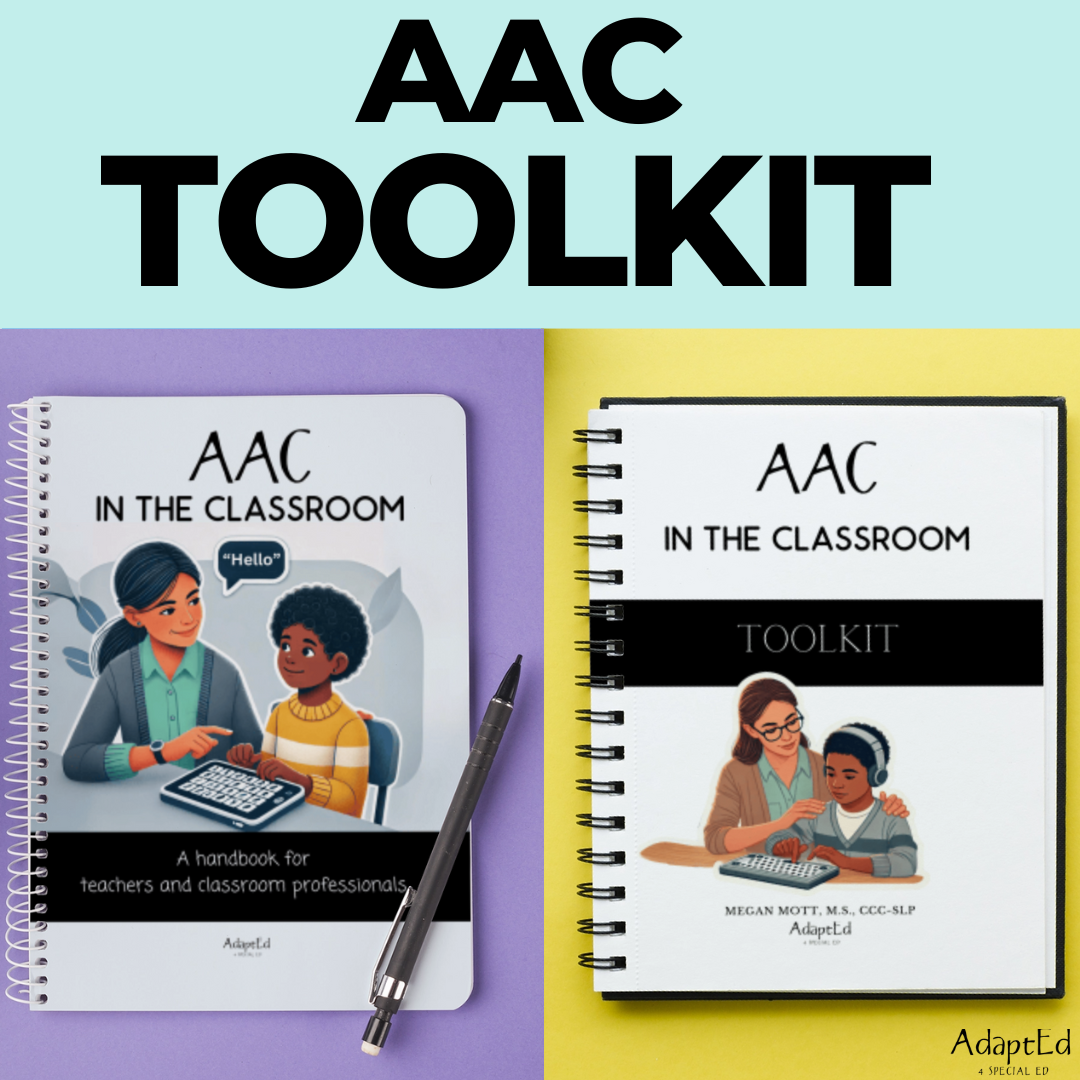
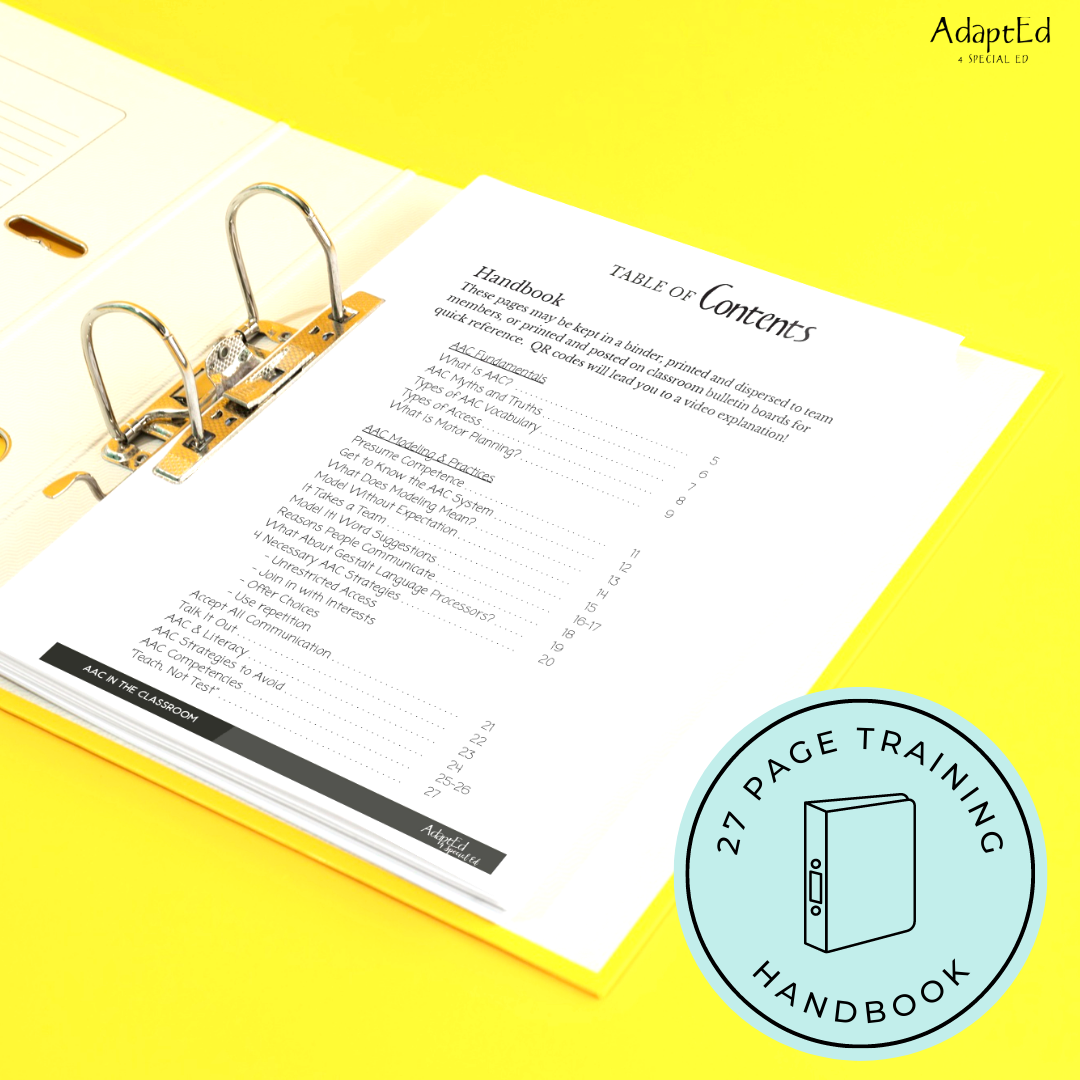
AAC Implementation Training Handbook Resource Toolkit (PDF)
The AAC Handbook and Toolkit is a great resource for educators who want to ensure the entire team (parents, teachers, support staff, etc.) has the knowledge and resources necessary for implementing and teaching AAC.
My love of AAC began years ago, when I worked with my first AAC client fresh out of school- an amazing girl with Cerebral Palsy who opened my eyes up to the world of AAC.
Along the way I've learned that many of us, no matter how great our intentions are, struggle to implement AAC in a way that works for students & their teams. My passion and goal is to make AAC implementation more straight-forward (and more enjoyable because AAC is so dang necessary)!
This AAC handbook gives you the information you need to get the whole team (teacher, SLP, professionals, paraprofessionals) on board with current AAC strategies.
This resources includes three sections as follows:
AAC Training Handbook
AAC Toolkit
the visuals and materials you need to embed AAC naturally throughout the day.
+ Video Instruction for each material to ensure the team knows how to implement each strategy effectively.
AAC Data Sheets
AAC Participation Plan
As a licensed SLP, I've had a lot of experience with AAC. I've witnessed, many times over, that AAC success hinges on one very important factor: consistency.
AAC users need and deserve consistent exposure to communication and modeling. To get this consistency, they need all important members of their life on board with their communication system.
It's no secret that many educational teams struggle with AAC consistency. Do I believe that this happens because teams don't care or put in the effort? No. I believe it happens because teams need more support.
A handbook can help people learn the basic skills that they need. (And that's why I wrote one!)
But I don't believe in stopping at a handbook.
I believe in supporting teachers and educational professionals in incorporating AAC into classrooms in a way that is simple, cohesive, and natural.
So, enter the AAC in the Toolkit.
This kit delivers a plethora of materials to get you started with ease.
Because your team doesn't just need AAC info dumped in your laps- - - You all need practical ways to help you implement what you've learned.
This resource also includes data sheets, classroom visuals, Google Slides access to edit the icons, core vocabulary boards, clear directions for modeling, AAC research citations, staff handouts, and so much more!
This packet does not include information about AAC assessment (which is really a separate training that is valuable to seek out). It is also important to note that this product may be used with any type of AAC. It will not give any device-specific information.
If you have any questions about this packet, please email me at krystie@adapted4specialed.com and I'll get back to you as soon as possible.
Spanish parent handbook is included.
___________________________________
Copyright © AdaptEd 4 Special Ed
Permission to copy for single classroom use only.
Please purchase additional licenses if you intend to share this product.
00
DAYS 00
HRS 00
MIN 00
SEC
DAYS 00
HRS 00
MIN 00
SEC
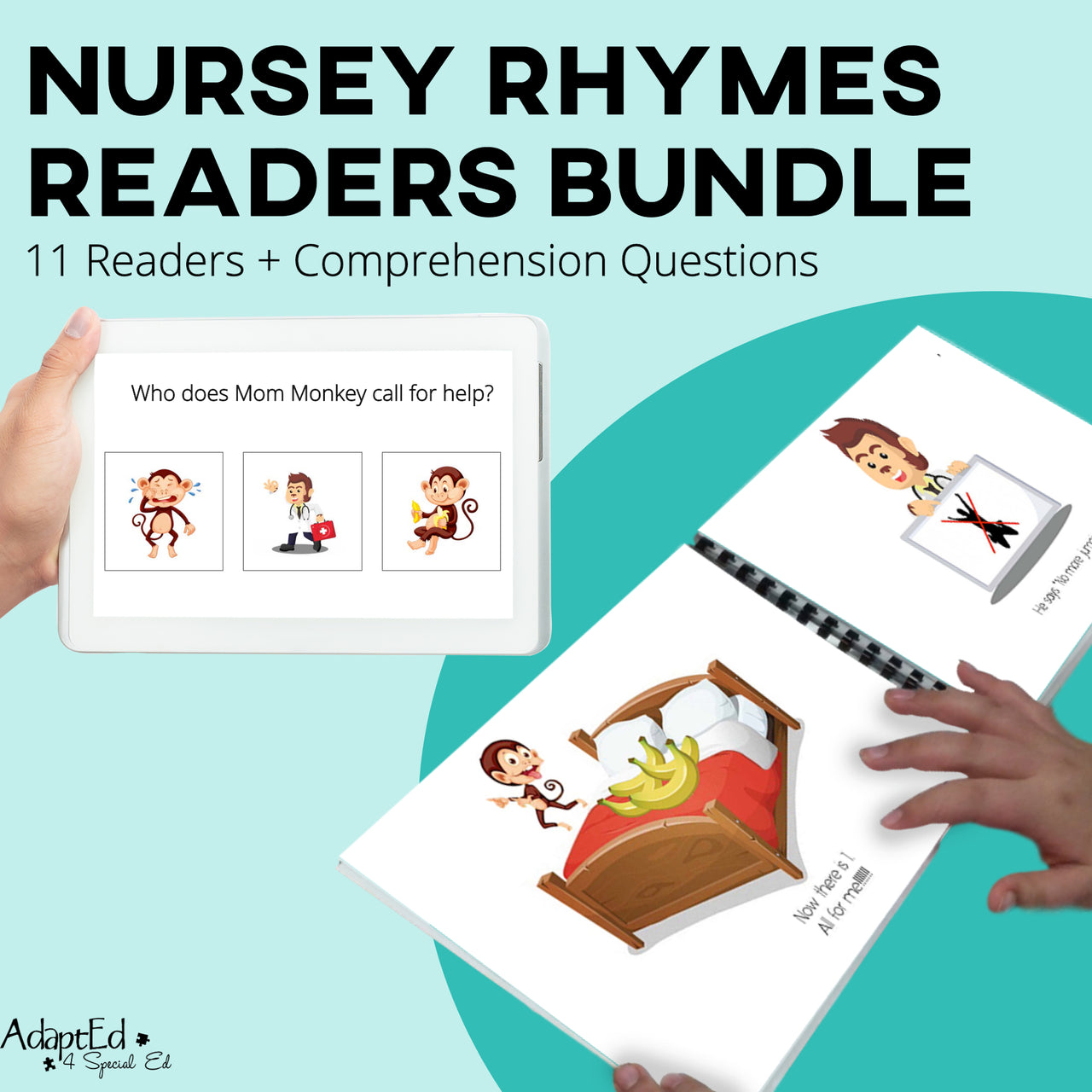
Nursery Rhymes Emergent Readers + Comprehension Bundle (Printable PDF)
Introducing the Nursery Rhymes Emergent Reader Bundle - a selection of classic rhymes rewritten using core vocabulary, designed to help students build language, reading, and reading comprehension skills.
This bundle includes versions of 11 popular nursery rhymes, each adapted to make use of sight words and other high-frequency words.
Reading these familiar rhymes will help to boost confidence and expand your students' reading abilities. So let's get started with some classic fun that helps young readers grow!
[ P R O D U C T • I N C L U D E S ]
22 Emergent Readers
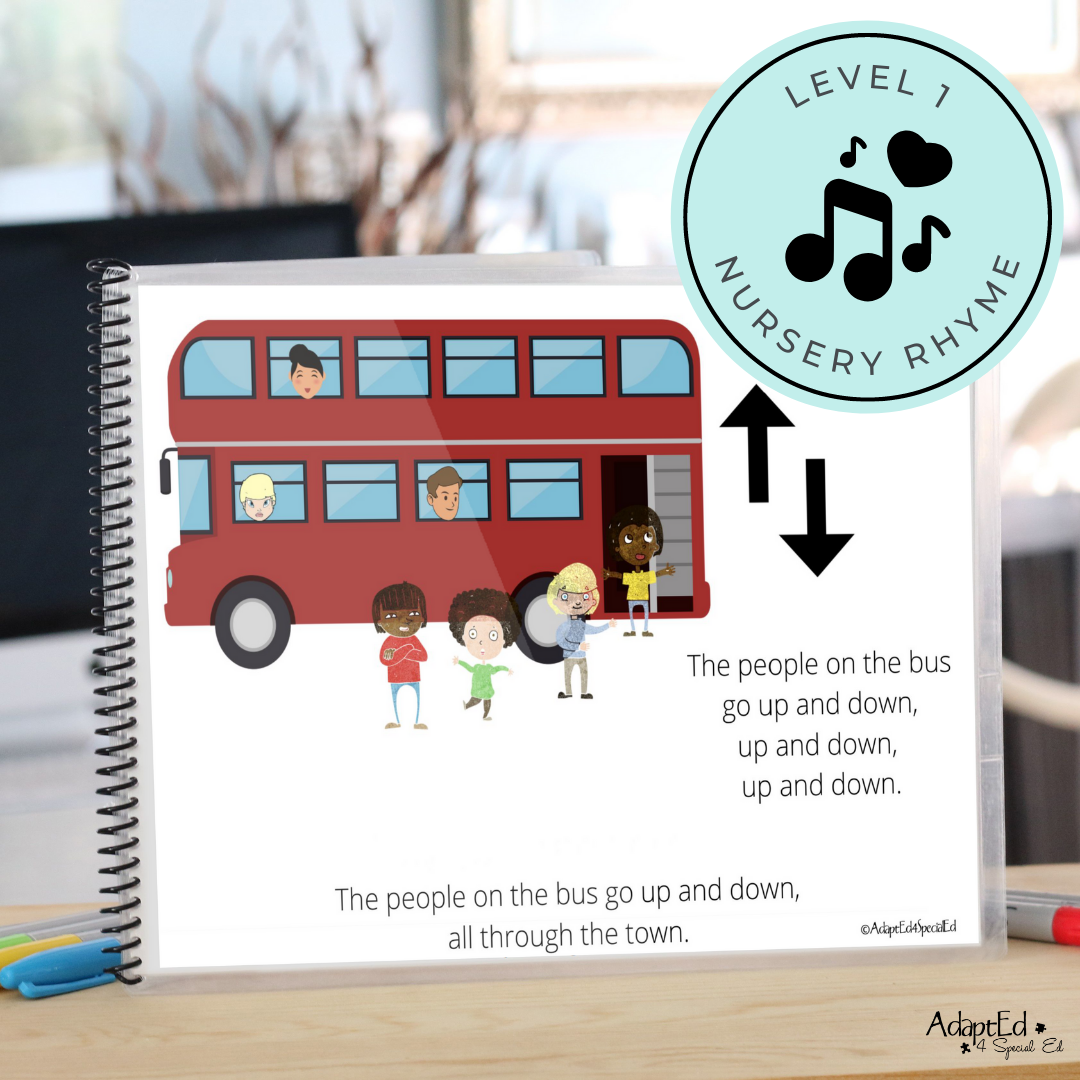
Level 1: Nursery Rhyme Song Reader
Level 2: Nursery Rhyme Core Word (aka sight words) version
Reading Comprehension Accompaniment
Visuals for Characters
Visuals for Settings
Story Event Sequencing Task
Visual Comprehension Questions
Nursery Rhymes:
Mary had a Little Lamb
The Wheels on the Bus
Jack and Jill
The Itsy Bitsy Spider
Baa Baa Black Sheep
Humpty Dumpty
The Five Little Ducks
On Top of Spaghetti
5 Little Monkeys
Sing a Song of Six Pence
Old MacDonald
[ R E C O M M E N D A T I O N S ]
Use on your iPad/ tablet to save on printing costs.
Project the book for the entire class to see, and avoid printing anything.
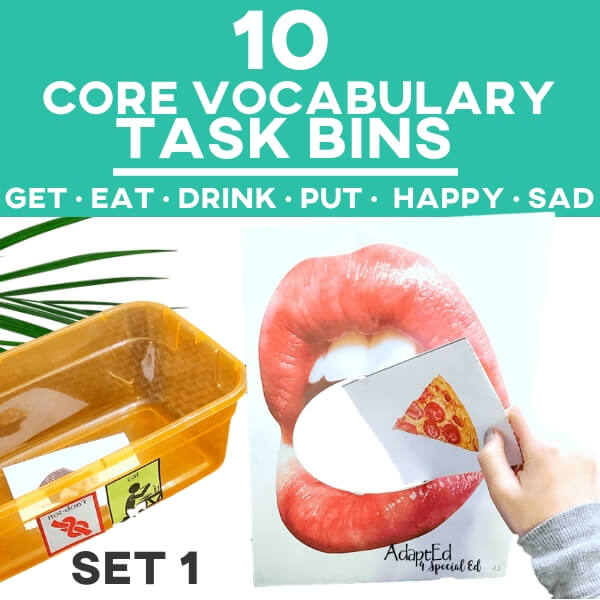
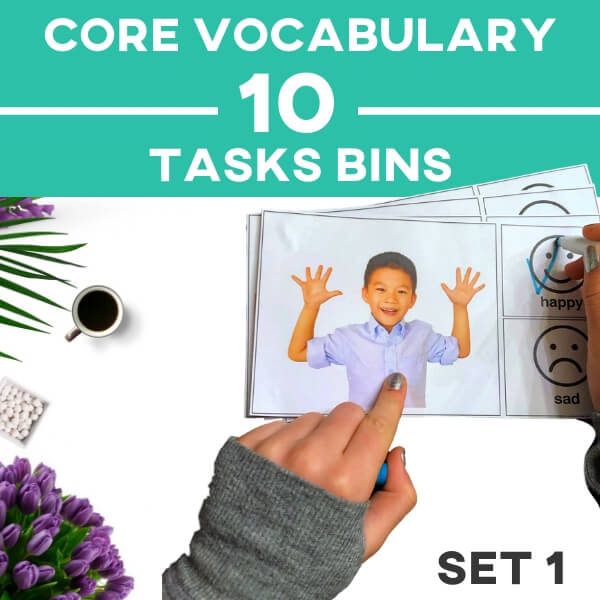
Core Vocabulary | Task Bins | Set 1: Get · Eat · Drink · Put · Happy · Sad
Ensure that your students get daily practice in the classroom by using these task boxes/task cards/rotation activities!
This set seriously makes core vocabulary AAC practice a no-brainer.
Great for both independent work as well as working with your paraprofessionals.
This is set 1 and it has everything you need to get lots of fun repetitive practice the following core vocabulary words: get, eat, drink, put, happy and sad.
Includes
Get:
Get/Don’t Get: Shopping List Task Bin
Get/Don’t Get: Gift Shopping Task
Get it: Sensory Bins
Eat:
Eat/Don’t Eat: Sorting Task Bin
Eat: Fine motor activity
Drink:
Drink/Don’t Drink: Sorting Task Bin
Put:
Put In: Utensil Sorting Task Bin
Put on: Counting Bears Task Bin
Put In: Recipe Task
Happy/Sad:
Happy/Sad: Emotion ID cards
That’s 10 complete core vocabulary tasks- totaling 98 pages of communication practice!
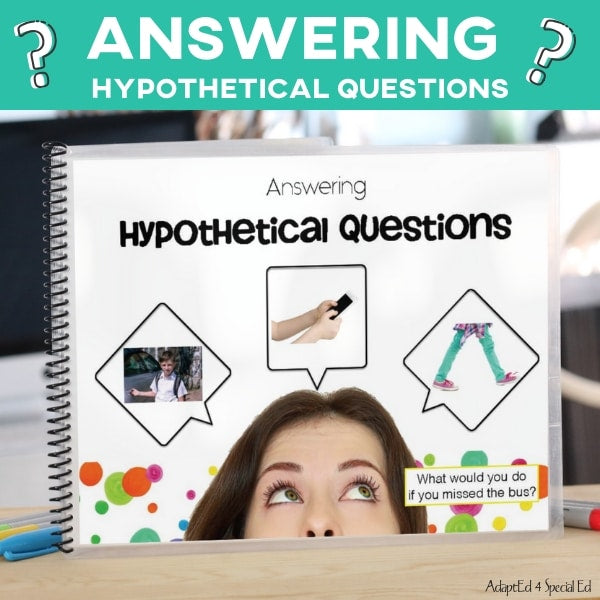
"Answering Hypothetical Questions" Activity Book (Printable PDF)
Do you want to teach your students how to think critically?
Answering Hypothetical Questions is an educational resource that provides teachers/ parents with a different approach to teaching hypothetical questions.
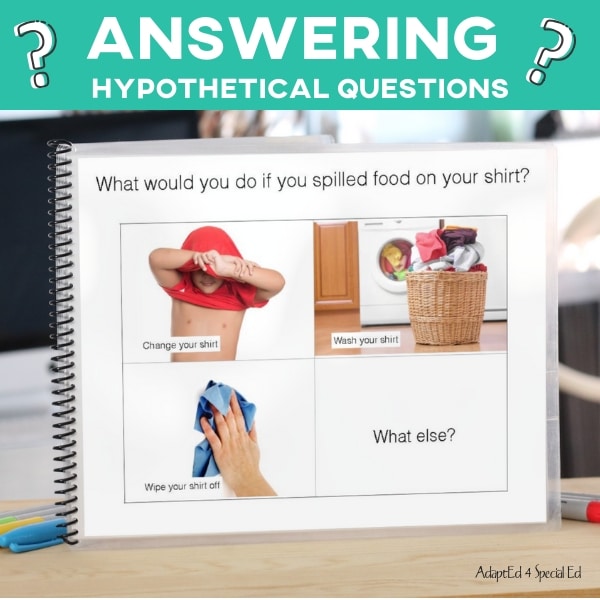
Rather than having the student identify the correct answer, this material focuses on providing and discussing multiple correct answers to hypothetical questions.
First, explore the options and talk about the different correct answers.
Then have your student select the answer that makes most sense for them! Includes 15 sets of hypothetical questions and possible correct answers. PDF | 8.2 MB | 35 pages
With this innovative approach, students will be able to learn more about themselves while also learning how others might think or feel in certain situations.
This unique method of teaching will allow your students to develop empathy skills they can use throughout their lives! Click "add to cart" if you're interested in downloading Answering Hypothetcal questions today!
Answering Hypothetical Questions
This product contains 15 sets of hypothetical questions and possible correct answers.
Each set of questions is accompanied by a discussion on the different correct answers.
The goal is to have students identify the best answer for them, rather than just identifying the correct answer.
These are great for studying or reviewing! They are also great for group discussions!
Hypothetical Questions Speech Therapy
I find myself writing IEP goals for hypothetical questions ALL the time.
But how we teach the skill is just as important!
Many times we get caught in the habit of teaching a single rote answer . . .
Question: What do you do if you feel sick?
Answer: “Go to the doctor.”
But do we all really go to the doctor when we are sick?
Or is that just ONE possibility?
After all, we want students thinking, not just memorizing answers!
Therefore, this material is a little different than your standard hypothetical questions deck.
Rather than having the student identify the correct answer, they will be asked what they would do if they were feeling sick and then given three options from which to choose one.
This way students can think about their own reasoning behind their decision rather than simply identifying an answer on a test or quiz without understanding why it was chosen over other possible responses.
Purchase this set today and give your students more opportunities for critical thinking skills development!
All pictures are real photographs in order to encourage generalization and independence.

Job Skills & Chores from A-Z | Career Readiness for Special Education & Home
Job skills, chores, and a working allowance system — from A to Z.
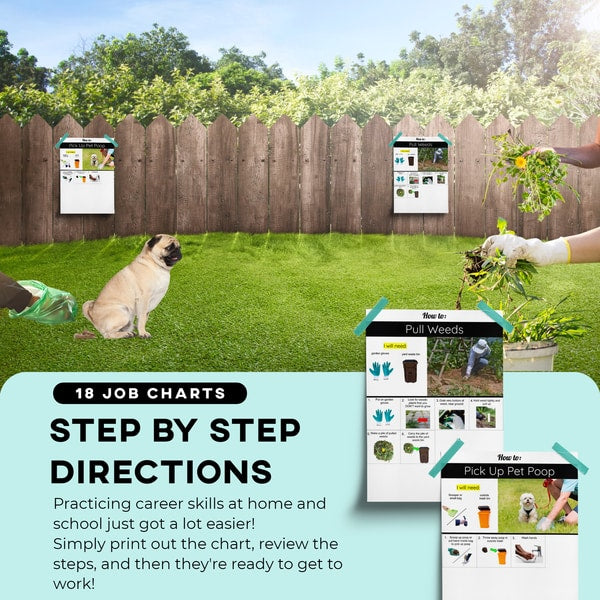
Job Skills & Chores from A–Z is a complete system for teaching work readiness through real job applications, interviews, paychecks, and step-by-step visual directions. Use it as a career readiness curriculum in the classroom, or as a structured chore-and-allowance system at home.
Built for secondary and transition-age learners in school, and for families teaching independence at home. Real photographs throughout. Step-by-step visual supports for every task. Fully editable so you can tailor the system to your students or your kids.
18 step-by-step job and chore posters. 3 levels of job applications. A full paycheck and allowance system.
Who this is for
In the classroom:
Secondary special education teachers running classroom job programs that double as transition skill-building
Transition program staff preparing students for employment after high school
Life skills and functional academics teachers looking for a structured, comprehensive career readiness system
At home:
Parents wanting chores broken down with clear visual directions instead of repeated verbal reminders
Families building an allowance system that ties earning to specific completed tasks
Homeschool families teaching work readiness alongside academic content
Parents of neurodivergent kids who need multi-step tasks visually scaffolded to follow through independently
Real photography and age-flexible framing make this work for middle school through transition-age learners, and for kids working on chores and allowance at home.
What's inside
18 step-by-step posters — Job and chore positions with visual directions showing exactly how to complete each task. Print, post, and reference.
Job applications (3 levels) — Differentiated forms students or kids can fill out to "apply" for jobs and chores, building real-world application experience.
Interview system — Structured practice for the conversation that comes before getting hired — useful for classroom simulation or family role-play.
Paycheck and economy system — A working money system with paychecks, money handling practice, and a purchase/reward system. Becomes a classroom economy at school or a chore-allowance system at home.
Job review and feedback system — Builds self-monitoring, independence, and the often-overlooked skill of accepting feedback from a teacher, supervisor, or parent.
Employee of the Month system — Recognition built into the structure, modeling how workplaces (and families) acknowledge consistent effort.
Workplace vocabulary stories — Real-image stories teaching essential words like "paycheck," "schedule," and "supervisor" in context.
Social narratives — Covering handshakes, dressing for interviews, and hygiene — the social and self-care skills that determine whether students keep the jobs they get.
Formats & delivery
💻 Printable PDF — Full system delivered as printable files. Print, laminate, and use across the school year or at home.
✏️ Editable text — Customize job titles, applications, paycheck amounts, kids' or students' names, and chore lists to match your specific context.
Purchase orders accepted. Email service@adapted4specialed.com


The Tower Treasure — Adapted Novel Study for Students with Significant Support Needs
A real chapter-book experience for students with significant support needs.
Many students with significant intellectual, communication, or learning needs spend years on short passages, simplified stories, and isolated worksheets, without ever getting to follow a chapter book from beginning to end.
The Tower Treasure changes that. Across 17 adapted chapters, students meet the characters, follow the mystery, notice clues, make predictions, answer questions, and come back week after week to find out what happens next.
17adapted chapters
700+Google Slides
17weeks of instruction
3printable journal formats
Written by a speech-language pathologist. Works with any AAC system. Instant download for projector, board, or tablet.
Everything included
17 fully adapted chapters of The Tower Treasure, rewritten in clear, accessible language
700+ Google Slides covering roughly 17 weeks of instruction
Visuals for important people, places, and events
What, who, and where preview questions for every chapter
Multiple-choice and open-ended comprehension questions
Interactive "try again" feedback when a student misses a question
Look-back screens that send students back into the story to find the answer
3 printable journal formats per chapter: cut-and-paste, fill-in-the-blank with word bank, and independent writing
Editable AAC icons to match your students' systems
Optional sensory items and tangible extensions for each chapter
Preview Chapter 1 free and see exactly how a lesson runs before you buy.
A chapter book they can actually be part of
The language is made more accessible. Visuals support understanding. Predictable routines help students know what comes next.
Students can participate by speaking, pointing, selecting an answer, partner-assisted scanning, using AAC, or writing.
The supports are substantial on purpose, but the experience still feels like a real book.
What does a week actually look like?
Students learn one predictable routine and use it through all 17 chapters:
Preview: What? Who? Where? questions introduce key people, places, and events.
Read: students follow the adapted chapter with clear language and visual support.
Answer: multiple-choice and open-ended questions check understanding.
Look back: students return to the story to find information and try again.
Journal: students respond using one of three differentiated printable formats.
The routine stays familiar while the mystery keeps changing.
What happens when a student gets it wrong?
They aren't simply marked wrong. They get a "Whoops, try again" screen and are directed back to the part of the story that can help them find the answer. Then they try again.
Students practice looking back at the text, finding information, and using what they read, all while continuing to solve the mystery.
Who is this for?
This resource was created for students who are too often left out of traditional chapter-book experiences, including students with:
Significant intellectual disabilities
Complex communication needs
Emerging literacy skills
Significant language and learning needs
AAC systems and other alternative ways to communicate
The content is written for older elementary through high school (roughly grades 3 to 12): mystery, danger, and problem-solving, not "little kid" plots. Mixed-age groups can read the same story together while you adjust the questions and response formats for each student.
Do my students need AAC to use this?
No. Visuals, accessible language, repetition, predictable routines, reduced writing demands, and multiple ways to respond make the story accessible to a much wider range of students with significant needs.
If your students do use AAC, the resource works with any system. Core-word-rich language, AAC modeling prompts, and editable icons let you match the visuals to whatever device or board your students already know.
Whole group, small group, or 1:1?
All three. Project the slides for shared reading and group discussion, pause to model responses on students' systems, use the comprehension questions as exit tickets or informal data, and extend with the printable journals.
Plan on roughly one chapter per week for a semester-long unit, or adjust the pacing to fit your group.
Can I buy this with a school purchase order?
Yes. Visit our purchase orders page for school and district ordering, or email service@adapted4specialed.com.
One mystery. Seventeen chapters.
Students aren't completing 17 disconnected reading passages. They're following the same characters, noticing clues, making predictions, looking back for answers, and coming back week after week to find out what happens next.
Because needing significant support shouldn't mean missing out on the experience of following a real story.
Read together. Follow the mystery. Find out what happens next.
Get the 17-Chapter Novel Study — $59.97
Instant digital download. Google Slides plus printable PDFs. Rated 4.8/5 by 3,355 customers.

AAC Play Companions Core Vocabulary (Printable PDF)
This set of play companions will help you to teach your students to engage in play in a natural and fun atmosphere.
Many of our students benefit from visuals, so why not use visuals to teach play skills?!? That’s the idea behind this visual companion set.
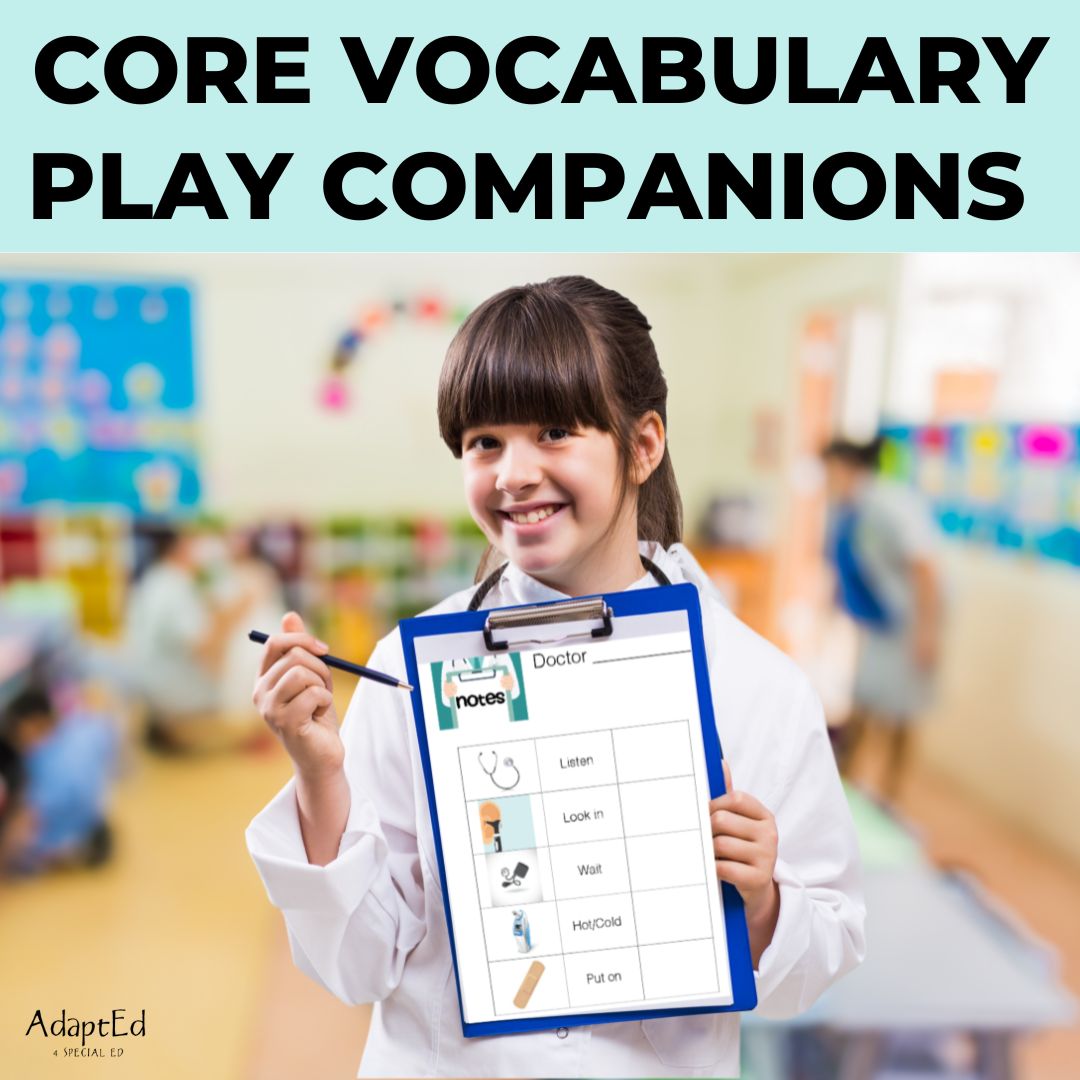
An adult models the play task by using a visual support that is carefully disguised as part of the play (Doctor’s notes, Parent’s To-Do List, etc).
When it’s the student’s turn they have the same visual support available to them. They simply check off the tasks as they go!
Visual supports mean less prompting and more INDEPENDENCE! Oh, and the visual supports are also paired with core vocabulary phrases appropriate for each play task. Let’s get them talking! Let’s get them playing!
We can all agree that teaching play skills is SOOO important. But why does it have to be so hard? Well . . . NOW IT DOESN’T have to be!!!
Details
50 Page PDF Download
Doctor Play:
Use the “Doctor’s Notes” and a toy doctor kit to perform “check ups” on peers.
Pet Play:
Choose a pet and take care of all its basic needs with the “Pet Owner’s To-Do List”.
Restaurant Play:
Take orders from peers and serve up meals with the “Waiter’s Notes” and menu.
Train Play:
Use language to set up a train track and direct traffic.
Baby Play:
Use the Parent’s “To-Do List” to take care of baby’s basic needs.
This set also includes BONUS scripts for lunch and recess times!
Break times are fantastic learning opportunities! Get your students using functional communication and core vocabulary during social moments.

00
DAYS 00
HRS 00
MIN 00
SEC
DAYS 00
HRS 00
MIN 00
SEC
Asking Questions BUNDLE (Printable PDF or Digital)
Are you looking for a way to teach your students how to ASK questions?
This set takes away that monotonous way of teaching questions where students are “quizzed” by their teacher or speech pathologist.
How it Works
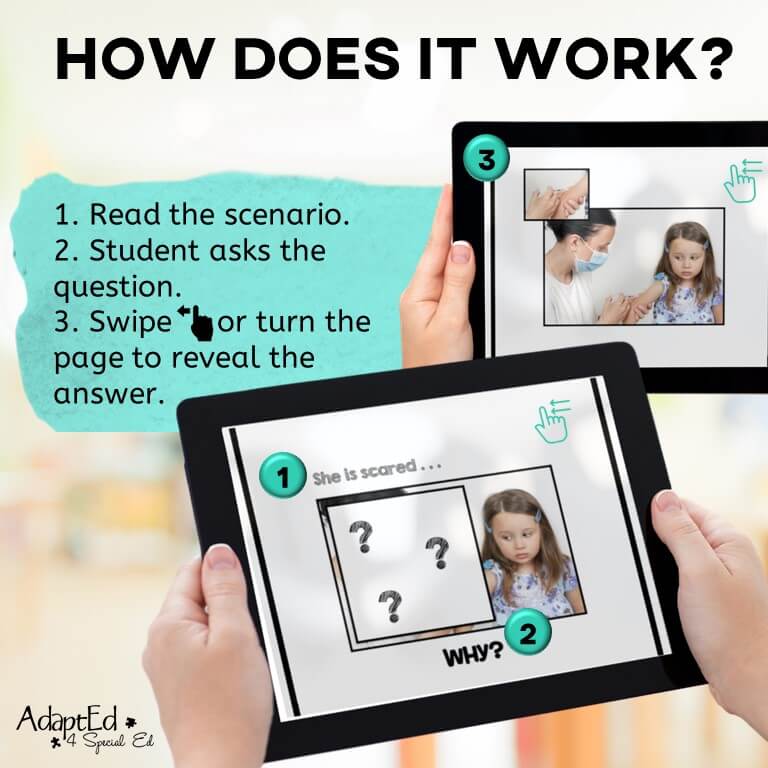
Instead, of "quizzing" our students, our Asking Questions BUNDLE provides vibrant images that act as visual cues for the students to learn to ASK and reveal the answers to their questions.
We've spent hours and hours finding the perfect images to keep your students engaged and interested. With these sets, they'll be asking questions in no time.
These hands-on and engaging language learning activities can be completed in therapy or the classroom.
What's Included
Each Set Contains 25 ask/ then reveal sets. 50 Pages each.
Asking Who 👪: 3 sets included.
1 set includes editable photographs where you can insert your student's faces in a matter of minutes.
Asking What 🍎: 5 themed sets included.
Garden, Party, Animal, Beach, Food
Asking How 🤔: 3 sets included.
Asking Where ⛰️: 3 sets included.
Animal homes, locations, "lost" edition
Asking Why 🤨: 3 sets included.
Asking When ⌚: 3 sets included.
Time, Morning/ Afternoon/ Night, Calendar
This set includes a series of 20 activities, and is nearly 1,000 pages long! 😮
Each set can be used in isolation or conjunction to get your students asking and answering questions independently!
