
Search results for "verbs":
Products
Action VERBS Adapted Books + File Folder Sorts (Printable PDF + Interactive Digital Versions)
Verbs are crucial for language development since they enable learners to begin constructing sentences.
Teach your students to master the 58 most common action verbs using this set.
Adapted Books
5 Action Verbs Adapted Books
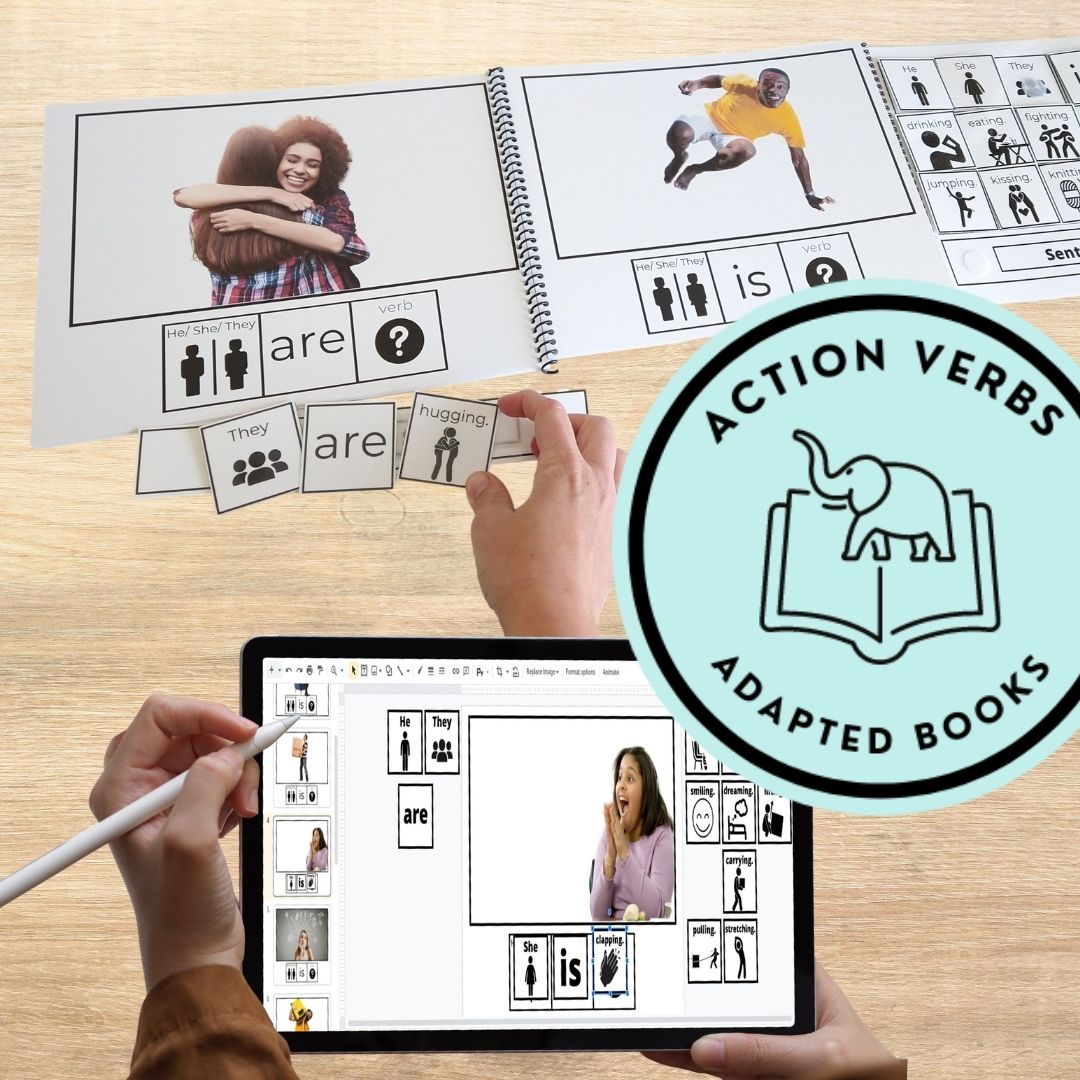
This resource targets the following sentence structure:
Pronoun + is/are + verb. (Who + doing what)
Each adapted book comes with 3 differentiated levels.
Level 1: Visually Supported Text
Level 2: Word Only
Level 3: Write the Sentence
Both printable and digital versions are included.
Picture Sorts
58 Action Verbs Picture Sorts
12 accompanying images per action word
Master vocabulary while sorting images
Both printable and digital versions are included.
Sentence Formulation
Students use an image of the action verb to formulate a complete sentence.
This resource targets the following sentence structures:
Subject + verb (Who + doing what)
Subject + verb + place (Who + doing what + where)
Target WH questions, formulating sentences, and early syntax while building sentences action verbs.
Both printable and digital versions are included.
Animal Actions Adapted Book VERB BUNDLE (Printable PDF + Digital)
Boost Their Skills with Adapted Books
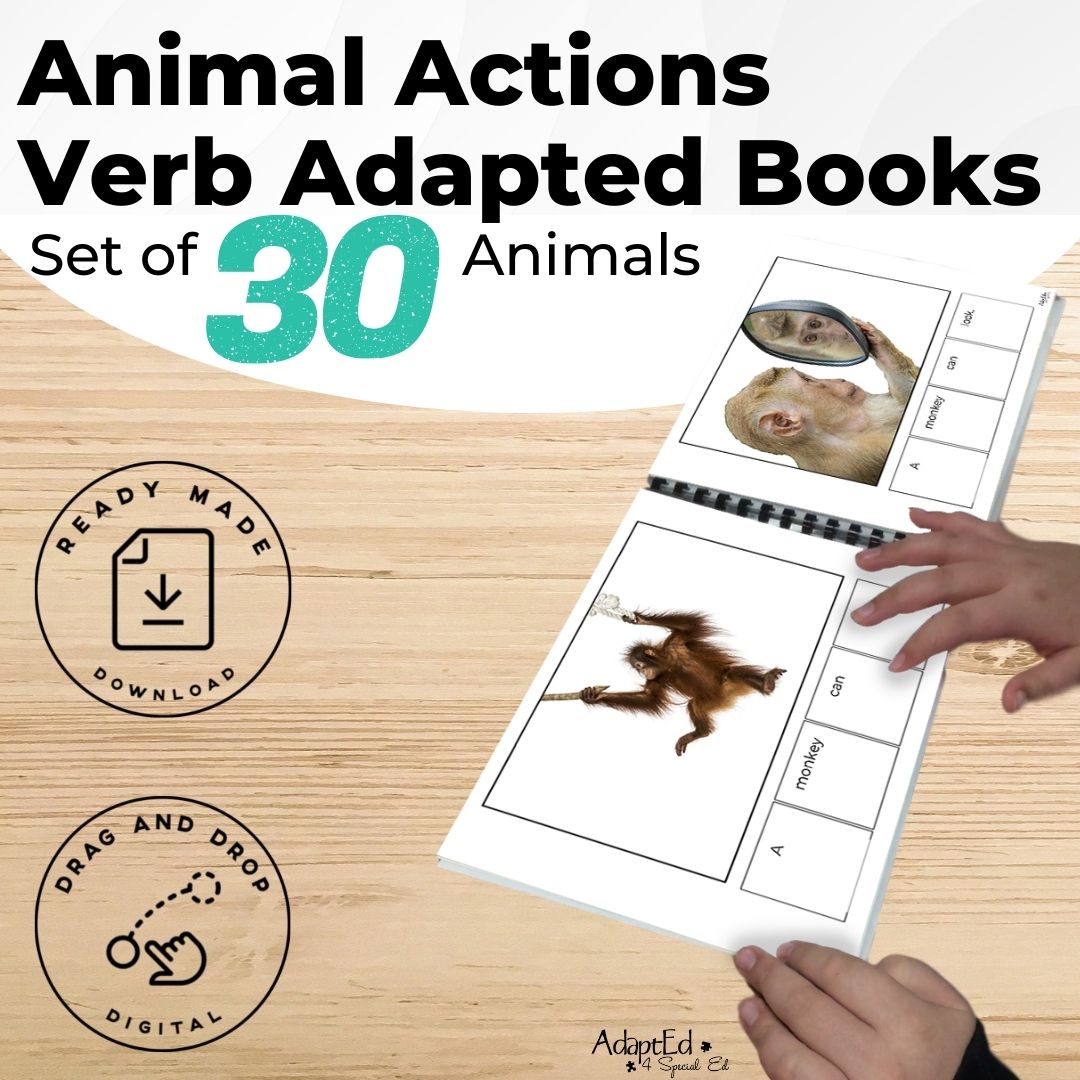
Practice identifying common verbs, while working on beginning writing skills and sentences structure.
Order now and receive both printable and digital versions of each book.
Books Included:
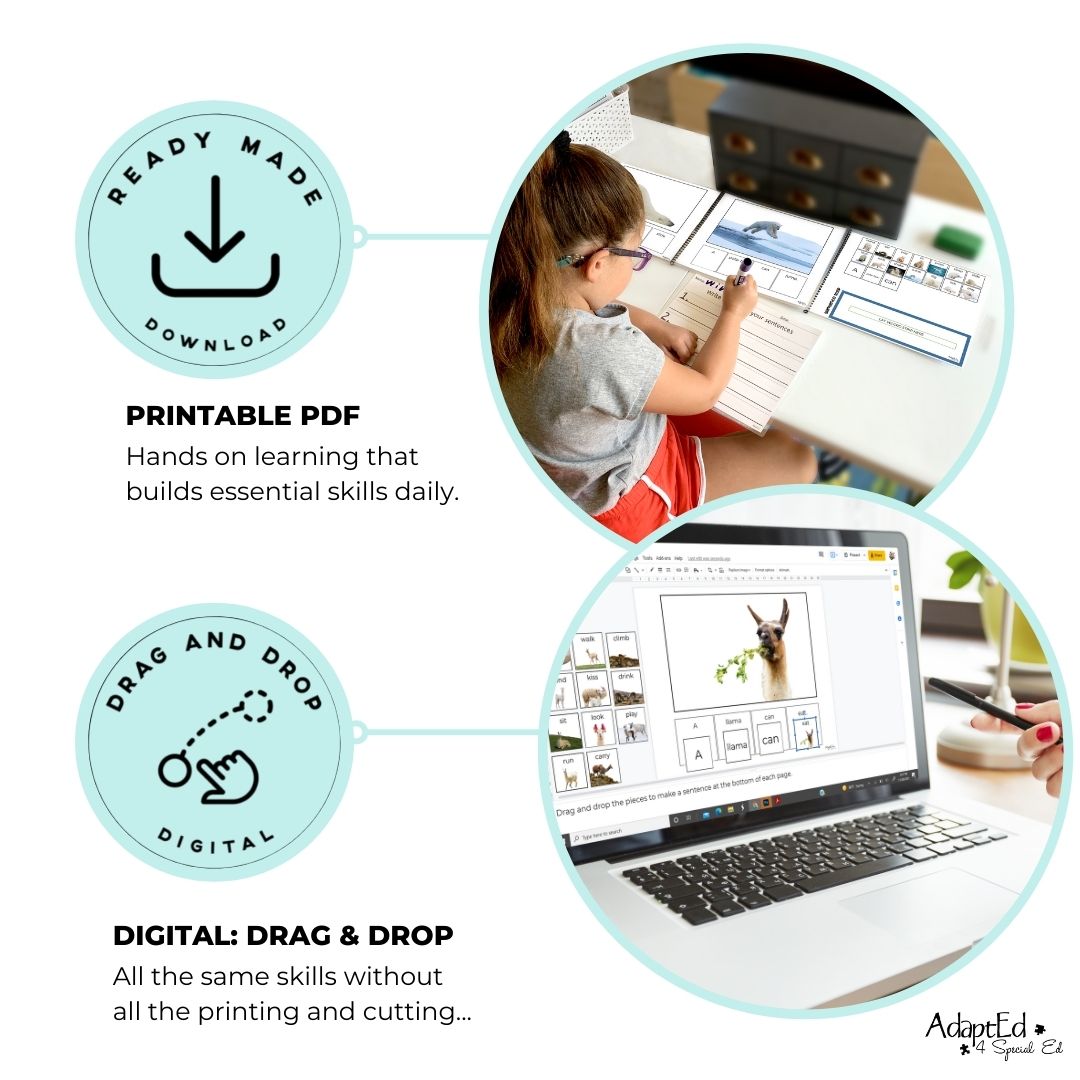
All Books Can Be Printed 🖨️ Or Used Interactively with Google Slides 💻
Order now and receive both printable and digital versions of each book.
Safari Animals
An Elephant Can..
A Giraffe Can…
A Lion Can…
A Zebra Can…
Pet Animals
A Dog Can…
A Cat Can…
A Bird Can…
Zoo Animals
A Penguin Can…
A Polar Bear Can...
A Llama Can…
A Monkey Can…
A Panda Can…
A Sloth Can…
A Tiger Can…
Farm Animals
A Horse Can...
A Cow Can…
A Donkey Can…
A Duck Can…
A Goat Can…
A Sheep Can…
A Pig Can...
Wild Animals
A Fox Can…
A Racoon Can…
A Skunk Can…
A Squirrel Can…
An Owl Can…
A Frog Can…
A Rabbit Can…
Australian Animals
A Koala Can…
A Kangaroo Can…
Adapted Books
Get your students engaged in their learning with these hands-on interactive books.
4 differentiated levels included to ensure that these book will meet the unique needs of YOUR students.
Digital Setup
Not minutes, seconds, seriously!
Digital Versions are saved on Google Slides™
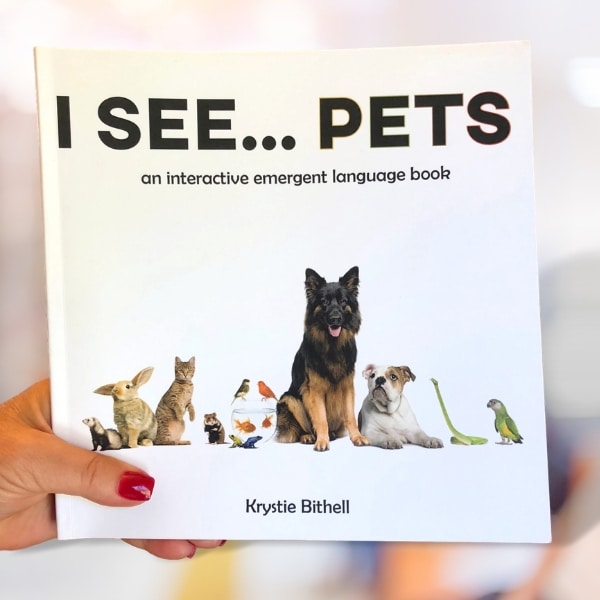
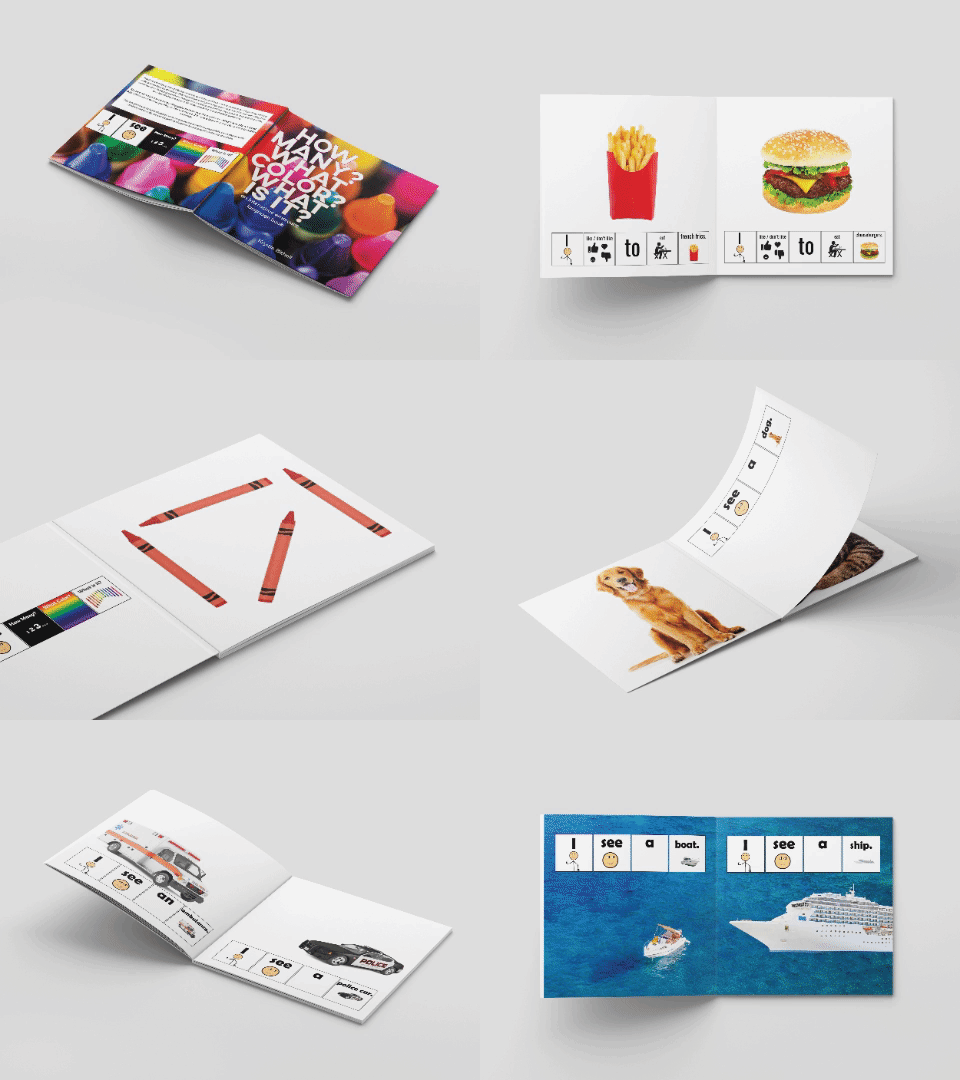
Emergent Readers 5 Book Set: Printed Books
Specifically written and designed for students with special needs, this set of 5 books is highly engaging, with colorful and vivid images, and attention-grabbing themes.
They focus on essential skills such as improving reading fluency, teaching sight words, and building CORE vocabulary.
Skills that are needed to help your child read more confidently, naturally, and eventually, independently.
Not only that, but also included with each book is the option to print and use sentence strips, making them interactive so students feel ENGAGED in their reading.
Professionally printed on-demand in the US.
Use code WEPAYSHIPPING at checkout to get FREE shipping (in the US) today.
Books
Each book is printed with a high gloss, durable cover, and measures 8.25” x 8.25”. Important note: these are printed on demand and delivery takes approximated 2-3 weeks.
Book 1 - VERBS 38 pages
Teaches action words and how to use them in sentences
Builds proper pronoun usage. (He/ She is... )
Book 2 - How Many? What Color? What Is It? Crayons 20 pages
Focuses on answering simple questions
Tackles basic concepts, counting skills and colors identification
Book 3 - I Like… I Don’t Like… To Eat 19 pages
Works on expressing opinions with proper sentence structure
This emergent reader builds core language, and expressing opinions is a high interest topic!
Book 4 - I See… Vehicles 19 pages
This high interest emergent reader will get your students reading independently!
Simple sentence structure and core vocabulary also helps improve MLU. (mean length of utterance)
Book 5 - I See… Pets 56 pages
This high interest emergent reader will get your students reading independently!
Simple sentence structure and core vocabulary also helps improve MLU. (mean length of utterance)
Details
This easy reader is a great tool to motivate reluctant and struggling readers to “read” along with you, or independently.
The simple and repetitive sentence structure is a great way to increase language and MLU (mean length of utterance) with struggling learners.
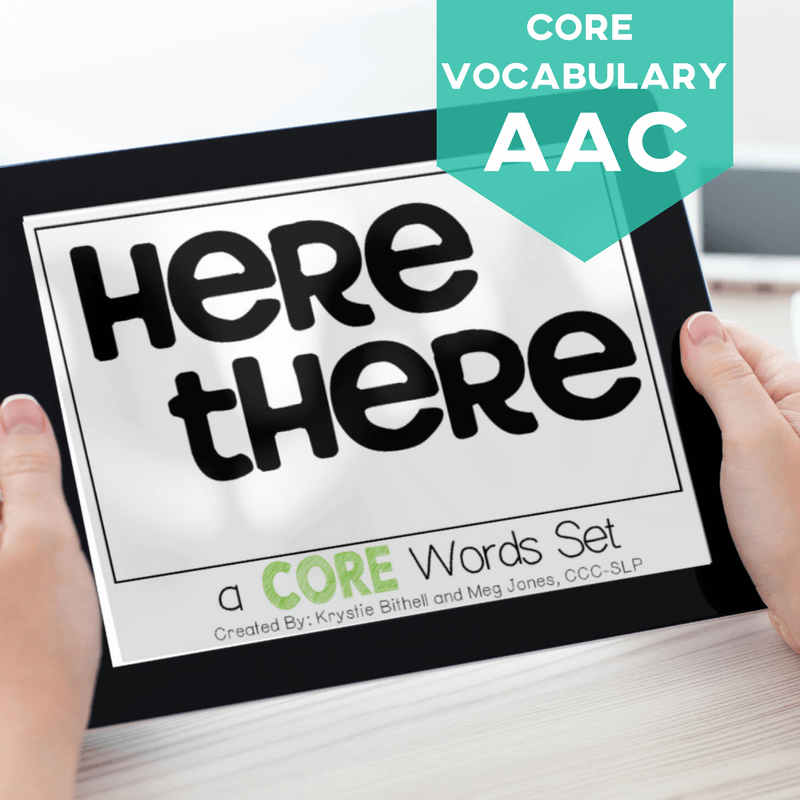
AAC CORE Words: "Here, There" Set (Printable PDF includes Books + Games + Word Work)
Here and There “2 Words for 2 Weeks,” a series of instructional activities and suggestions for using target core vocabulary words with our students. Why “here” and “there”? These words are powerful for our students because here/ there can be used for many communicative functions.
Includes
This packet is HUGE! It provides a full 2 weeks of instructional materials if you are completing tasks daily. With CORE language the focus is on getting students to truly develop their language, by understanding the words and how they are used across multiple settings and environments.
Everything you need to get started is included in this packet! :) Happy teaching!
Core Vocabulary Language Books
Come Here! (12 pages) - this adorable book has your students finding dogs making not the best choices, their job is to tell the dog to "Come here!" before he creates more of a mess!
Where is it? Here it is? Find the Elf (22 Pages)- Your students can partner up with this book having one of them practice reading/ asking the question "Where is it?" while the other finds the elf and says "Here it is."
Look There Fairy (25 pages) Another look and find book, but this time your student will practice saying "Look there" to direct another person's attention to the location of a fairy hidden in the images.
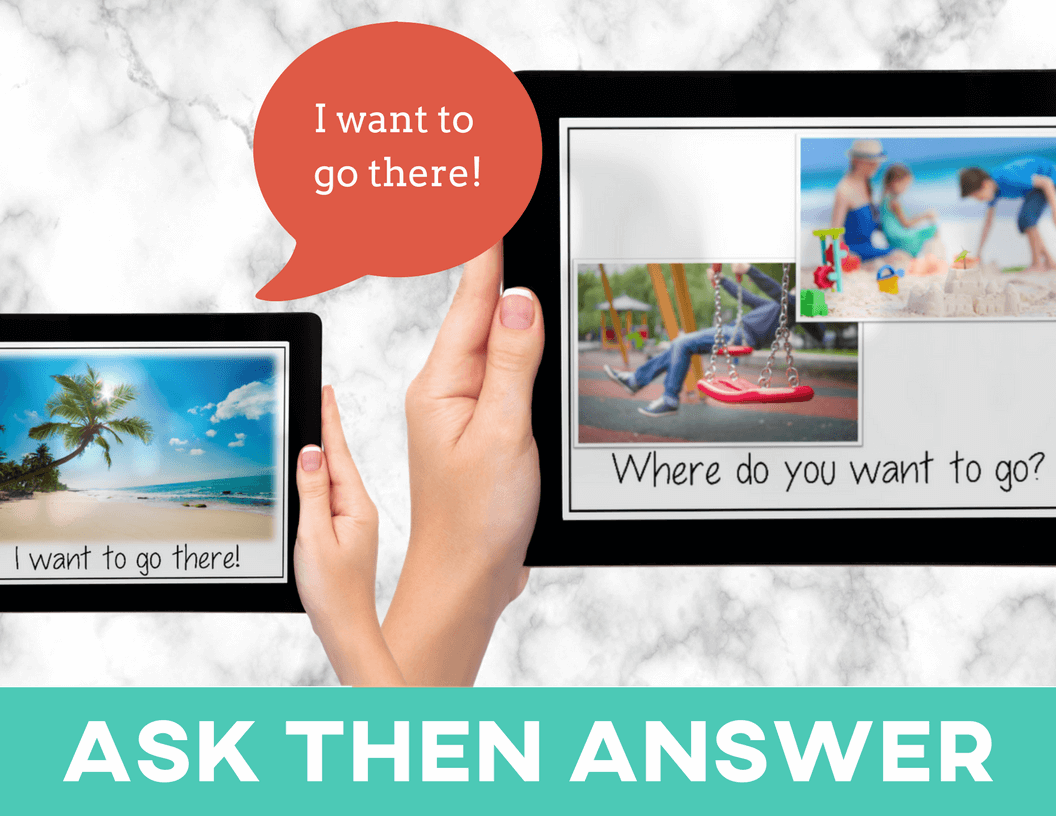
I Want to go... There (13 pages) Your student will be able to express their desire by choosing a location they'd rather go. The question is asked, "Where do you want to go," and they can respond with, "I want to go there" and indicate their choice. The later pages in the book show something/ someone and 2 habitats, your student will indicate where it should be. (ex: a baby: in a crib or on a rollercoaster)
Here/ There Game (13 Pages)
Where does it go? Practice putting everyday household items away with this Here/ There Mat Game. Students draw a card and place it on the mat where it belongs. (ex: plate goes in the kitchen). When they place it down they should say "here" or "there."
11 Word Work No Prep Pages
Information about CORE language, and where to find support to begin the process of going CORE with your students.
This packet is based on a selection of core vocabulary, or the highest frequency words in speech and writing. Remarkably, these seemingly simple words make up roughly 80% of what we say!
They can be used and combined for a full variety of communicative functions (such as initiation, termination, commenting, requesting, asking, interjecting and directing others). Teaching core vocabulary allows students the chance to do more than just get their needs and wants met, but to develop authentic language skills!
Modeling and repetition are important parts of core vocabulary learning and instruction.
You may notice that some products contain repetitive refrains or frequent repetitions of the same core words.
This is done with the intent of getting the most repetition and practice possible while still having fun!
Great for Independent Work Station
Core Suggestions
Suggestions for using core vocabulary communications boards/ AAC Devices:
1) It’s okay to be slow! Your students will need the extra time to find icons and follow your models, so going slow is only beneficial!
2) Model, model, model. Students learn by watching you use the core board/ device and hearing you speak the words. If your student is hesitant about touching the board at first, then for now you can settle for letting them attend to you using the board. This can be a nice introduction to the idea that the boards are there for communication.
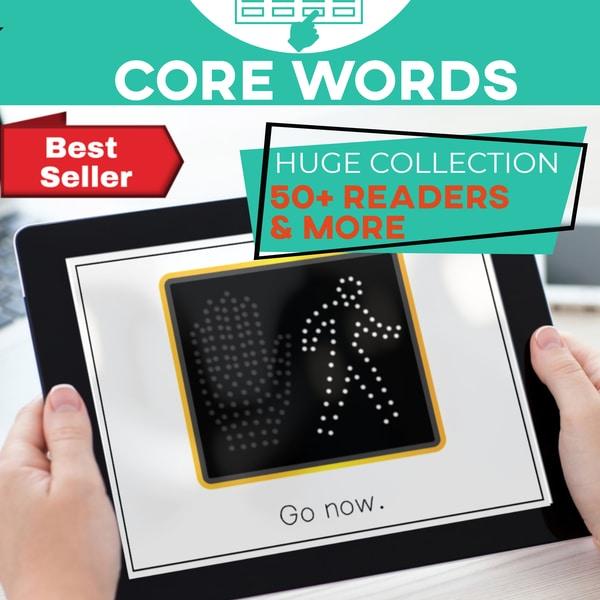
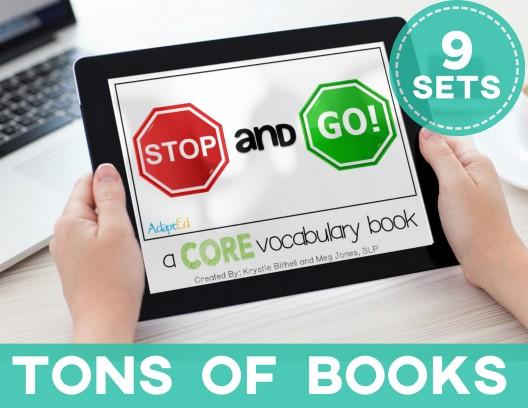
3) You are NOT limited to only using the words “stop” and ‘go.” These words should be the focus of the next two weeks, but feel free to be modeling words and phrases as appropriate in all settings. Also, when you are modeling use of the board you do not need to touch an icon for every single word that you say. For example, you may tell a student “Look at your work,” but the only icon you touch might be “look.”
4) Everybody should be on board. All staff members who interact with the students should get familiar using the core board. This is now a way that we can all communicate with each other.
00
DAYS 00
HRS 00
MIN 00
SEC
DAYS 00
HRS 00
MIN 00
SEC
Core Words Mega BUNDLE (Printable PDF's)
Core Vocabulary Put the Words That Pack a Punch
Into Your AAC Users Vocabulary
Roughly 80% of What We Say Consists of Just 300 Words
When you teach your students CORE vocabulary, you're giving them so much more than just a few words.
You're giving them a way to communicate!
List of What's Included
19 Focus Core Words: Big, Little, Dirty, Clean, Go, Stop, Good, Bad, Here, There, Look, Like, Now, Ready, Later, This, That, Turn and Do.
Each set comes with Core Books, Games, Word Work, Core Words Focus Phrases (for modeling language)
Big and Little Core Words Set Core Books:
Big or Little
Get Big or Get Little
Growing Up Little to Big
Games:
Big/ Little BINGO
Big/ Little Matching Game
Big/ Little Word Work Big and Little Focus Words PostersBig and Little CORE Phrases to Model Dirty and Clean Core Words Set Core Books:
Clean or Dirty?
Do You Like Getting Dirty?
Help Me Clean Now
Games: Dirty/ Clean Dirty/ Clean Word Work Dirty and Clean Focus Words PostersDirty and Clean CORE Phrases to Model Go and Stop Core Words Set Core Books:
Come in, Go Away!
Go, Go, Go!
Stop, Please!
We Go
Games:
Stop and Go Signs
Stop, Go Game
Go and Stop Word Work Go and Stop Focus Words PostersGo and Stop CORE Phrases to Model Good and Bad Core Words Set Core Books:
Good Boy... Bad Boy
Good or Bad
How Does it Look?
Games: Good Dog, Bad Dog Matching GameGood and Bad Word Work Good and Bad Focus Words PostersGood and Bad CORE Phrases to Model Here and There Core Words Set Core Books:
Come Here!
Elf HUNT
I Want to Go... THERE
There it is Fairy
Games: Here/ There Game Here and There Word Work Here and There Focus Words PostersHere and There CORE Phrases to Model Look and Like Core Words Set Core Books:
Eat Like A...
Look at Me
Look, Do you like it?
Look, Do you like it? 2
Look, Don't Look
We Like to Play
Look and Like Word Work Look and Like Focus Words PostersLook and Like CORE Phrases to Model Now, Ready and Later Core Words Set Core Books:
Are You Ready?
Get Ready
Now or Later?
Games: Now or Later Game Now, Later Word Work Now, Ready, Later Focus Words PostersNow, Ready, Later CORE Phrases to Model This and That Core Words Set Core Books:
Don't Eat That!
Get This, Get That
I Want That!
Take this, Don't take that (Beach)
Take this, Don't take that (School)
This and That Word Work This and That Focus Words PostersThis and That CORE Phrases to Model Turn and Do Core Words Set Core Books:
Do Your Work!
I do it, You do it!
Turn it
Who Does?
Whose Turn?
Turn and Do Word WorkTurn and Do Focus Words PostersTurn and Do CORE Phrases to Model + 3 Of our Hugely Popular CORE Adapted Fairytales to get you started! BONUS Now includes Core Vocabulary Motivational Posters
Keep Calm and Model On
Keep it Simple and Keep it Core
All you need is CORE
Yes I can
This this. Core words
Give me a turn
I want that now
I will do it!
Each poster comes in full color and printer friendly versions. As well as focus keyword posters to keep everyone on your team on the same page. Great for Independent Work Stations
Why Go Core?
When you teach your students CORE vocabulary, you're giving them so much more than just a few words.
You're giving them the words they need to start a conversation, to comment to a friend, or to ask for something they want, or interject into a conversation.
Simply put, you're giving them the words they need to communicate. Instead of teaching your student to say- "Apple...Apple...Apple" by handing them a laminated picture of an apple.
They'll be able to say- "want more" or point and say "there" to indicate where their snack is.
Core words are the words we all use to communicate with each other every day. Give your students the words they need to develop true language skills, don't hold them back to simply requesting items that are in their immediate vicinity. Are you ready for the best part?
Teaching core words are... way easier than picture exchange systems! No more printing/ cutting/ laminating the same set of nouns, only to have them destroyed or lost in a few days. If you're teaching non-verbal students you can use a speech generating device or the low tech version- core boards (we've supplied you with a link if you don't already have one) and you just print and laminate, that's it, everything they need is just on one page, and no more moving pieces to lose, it's amazing! We hope you're ready to switch over, and Go CORE. This packet has everything you need to get started! This packet is HUGE! It provides a plethora of resources to your students engaged and communicating. With CORE language the focus is on getting students to truly develop their language, by understanding the words and how they are used in conversation.Get started with focus word sets.
This product has 19 focus words + a few our super popular CORE Adapted Fairytales to get you started with Core Vocabulary
Guarantee
All of our products are classroom tested and therapy tested- we’ve used them ourselves and know that they are effective! AdaptEd is made up of a team (SLP, OT and SPED teacher / AT Specialist) so that we can offer you the best, and the most reliable resources possible.
We know how frustrating it can be to spend your hard earned money on something- only to open it and find out it’s not what you were looking for. That- this simply is not going to do anything useful for you or your students.
We don’t want that- and we know you don’t either! If you’re not completely satisfied with your download email us at krystie@adapted4specialed.com and let us know. We’d love to see how we can fix it!


When Learning Hits the Wall
When learning gets stopped in its tracks, something is in the way.
Our newest handbook, When Learning Hits the Wall, helps educators make sense of those moments—when a student shuts down, rushes through work, or simply disengages—and respond with clarity instead of guesswork, even when they’ve already tried “everything.”
It focuses on helping identify what system is breaking down in the moment and what needs to change so learning can resume. The book introduces a practical, research-grounded, barrier-based framework for matching support to real barriers—while keeping learning goals intact.
Choose Digital, Print, or Both to access When Learning Hits the Wall.
How This Book Supports Educators, Teams, and Families
Better understand why learning breaks down in the moment
Respond to shutdowns, rushing, and disengagement with clarity
Match support to what’s blocking access
Keep learning goals intact while restoring access to learning
Who this is for (and who it’s not)
Teachers in inclusive classrooms who need practical, in-the-moment ways to respond when students shut down, freeze, rush through work, or disengage
Educators asked to “differentiate” or “provide accommodations” without a clear framework for deciding what actually needs to change
Teachers supporting twice-exceptional, undiagnosed, or inconsistently accessing learners, where needs shift depending on task, pace, or environment
School leaders and instructional coaches working to improve consistency and accuracy in support decisions across classrooms
IEP and problem-solving teams frustrated by vague accommodations (like “preferential seating” or “extra time”) that don’t reliably restore access
Teams seeking clarity without increasing documentation or compliance burden
Parents and caregivers trying to understand why supports aren’t working—not just what supports are being used
What’s inside
This book provides a clear, repeatable way to understand why learning breaks down—and how to restore access when it does.
First: A practical framework for identifying learning breakdownsLearn how to better identify what’s actually getting in the way when a student freezes, shuts down, rushes, or disengages.
Then: A shared language for understanding barriersClarifies the difference between task demands, domains, hidden barriers, and access conditions—so decisions stay focused and consistent.
At the core: The six hidden barriers that drive most learning strugglesClear explanations of processing speed, working memory, task initiation, attention shifting, organization & sequencing, and regulation load—with real classroom examples.
Tools for identifying barriers in the momentQuick scans, flowcharts, and observation prompts designed to support real-time decisions, not after-the-fact analysis.
Guidance for matching support to the barrier—not the behaviorLearn when accommodations restore access, when modifications are appropriate, and why good intentions sometimes lead to the wrong support.
Barrier-based accommodation examples that actually generalizePractical ways to adjust pace, language, structure, and conditions so students can engage with the same learning goals.
Disability snapshots as starting points—not conclusionsADHD, autism, dyslexia, DLD, mental health, intellectual disability, trauma, and TBI—included to support observation and context, not to prescribe support.
Language that protects dignity and restores accessScripts and framing that help students re-enter learning without increasing pressure, shame, or confusion.
This book is designed to be used flexibly—read cover to cover, referenced during planning, or pulled out in the middle of a tough moment when learning hits the wall.
Below is the full table of contents, so you can see exactly how the framework is structured.
Formats, delivery & purchase orders
📦 Spiral-bound print
💻 Digital PDF — instant access
Purchase orders accepted. Email service@adapted4specialed.com
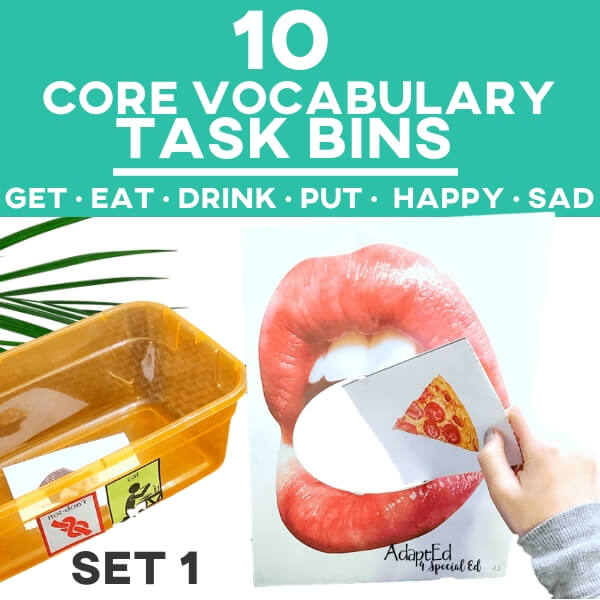
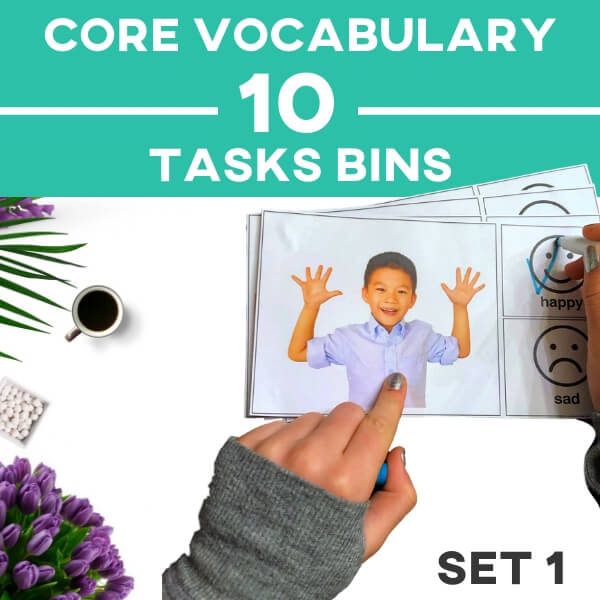
Core Vocabulary | Task Bins | Set 1: Get · Eat · Drink · Put · Happy · Sad
Ensure that your students get daily practice in the classroom by using these task boxes/task cards/rotation activities!
This set seriously makes core vocabulary AAC practice a no-brainer.
Great for both independent work as well as working with your paraprofessionals.
This is set 1 and it has everything you need to get lots of fun repetitive practice the following core vocabulary words: get, eat, drink, put, happy and sad.
Includes
Get:
Get/Don’t Get: Shopping List Task Bin
Get/Don’t Get: Gift Shopping Task
Get it: Sensory Bins
Eat:
Eat/Don’t Eat: Sorting Task Bin
Eat: Fine motor activity
Drink:
Drink/Don’t Drink: Sorting Task Bin
Put:
Put In: Utensil Sorting Task Bin
Put on: Counting Bears Task Bin
Put In: Recipe Task
Happy/Sad:
Happy/Sad: Emotion ID cards
That’s 10 complete core vocabulary tasks- totaling 98 pages of communication practice!


Safe to Learn Handbook
The Foundations of Co-Regulation, Trauma-Informed Practice, and Inclusive SEL
“Practical, real, and exactly what educators need right now.”— Alissa Kostopoulos, BCBA
Before students can learn, they must feel safe. Safe to Learn bridges the gap between big ideas and daily practice—giving teachers, administrators, support staff, and families tools they can use right away.
✨ What’s Inside
Regulation before expectation → why nervous system safety is the first curriculum.
Daily co-regulation strategies → go beyond “calm down” scripts to build real connection.
A trauma-informed lens → reframe fight, flight, freeze, and fawn as survival—not misbehavior.
Explicit teaching of self-regulation → build routines instead of assuming students “just know.”
UDL & sensory checklists → design classrooms where every student feels safe.
Family + caregiver guides → bridge support between home and school.
Leadership reflection tools → help admins model regulation and reduce burnout.
🛠 Tools You’ll Use Right Away
Reflection guides for educators & leaders
Family–school collaboration checklist
One-page caregiver guide to co-regulation
Administrative walkthrough forms & classroom maps
Strategy banks, sensory supports, and explicit teaching examples
📦 Choose Your Format
Digital PDF → instant access
Spiral-Bound Print → lays flat, perfect for PD
Bundle (Best Value) → both for the price of print during early release 🎉 Limited-time offer
💡 Why It Matters
When students feel safe, they don’t just behave better—they learn better.When educators feel equipped, they don’t just survive—they thrive.
Choose your format and start building safer, stronger schools.


AAC Core Word Builder Set 2 | 20 Weeks of No-Prep Speech Therapy Lessons for SLPs
Just 80 words make up about half of everyday English. Set 2 takes students from foundation to fluency.
AAC Core Word Builder: Set 2 is the second 20 weeks of a structured, year-long curriculum—building on Set 1's foundation with vocabulary that introduces regulation, evaluation, and richer interaction. From Stop and Look to Happy and Different, these are the words that move students from basic requesting to genuine conversation.
Created by Meg Mott, M.S., CCC-SLP, AdaptEd's resident AAC specialist and parent of an autistic son. Originally built for teletherapy in 2020 and refined across years of real classroom and clinic use, this curriculum is now trusted by SLPs, special educators, and AAC teams across the country.
Set 2 covers 20 high-frequency core words across 20 weeks—each taught through seven coordinated activities designed to build fluency, regulation, and generalization.
What this curriculum gives you
20 weeks of ready-to-use AAC lessons—no prep beyond opening the file
A consistent weekly structure across all 20 lessons, so students know what to expect
Vocabulary that builds on Set 1's foundation with regulatory, evaluative, and emotional core words
Multi-modal activities that engage attention, body, and family—not just the screen
Generalization built in through parent handouts and homework that extend learning beyond the session
Who this is for
SLPs looking for structured, evidence-aligned AAC instruction without spending Sunday nights building lessons from scratch
Special education teachers supporting students with complex communication needs who want a curriculum they can actually run
Teletherapy and hybrid clinicians who need engaging, screen-friendly materials that hold attention across digital sessions
AAC teams looking for shared lesson materials that align across providers, classrooms, and home
Parents wanting to extend AAC learning at home with structured guidance, not generic suggestions
What's inside each weekly lesson
Each of the 20 weeks centers on one core word, taught through seven coordinated activities:
Introductory GameA low-pressure activity individually crafted for each lesson, designed to introduce the target word without performance pressure.
Animated E-BookReal photographs arranged into a unique book for each word—minimum 10 pages, with movement on every page to hold attention and reinforce the word in context.
Movement BreakA targeted movement activity tied to the target word—from a simple linked dance video to a custom movement game—that builds regulation into the lesson.
Additional ActivityAn extra engagement that may center on a song, a video, a book extension, or a guided drawing, giving you variation across the week.
Parent HandoutA take-home guide for every word, so families have direction for practicing core vocabulary at home and learning generalizes across settings.
HomeworkA simple homework activity, easily shared electronically—including a flexible "book report" format that works any week of the curriculum.
The 20 core words you'll teach in Set 2
Set 2's vocabulary builds on Set 1's foundation, introducing the words that move students from basic requesting to richer, more nuanced communication—regulation words like Stop and Wait, evaluation words like Good and Bad, and emotional vocabulary like Happy and Sick.
Stop
Get
Look/See
Up
Good
Make
Work
In
Who
Read
Different
Bad
Hear/Listen
Take
Do
Again
Wait
Happy
Sick
Out
Continue the curriculum with Set 1 and Set 3
Set 2 builds on the foundation laid by Set 1 and continues toward Set 3's completing vocabulary. Together, the three sets provide a full school year of structured AAC instruction.
Set 1 — Weeks 1–20The foundation: Go, Help, More, Eat, Want, and the first words students need to ask, request, and connect.
Set 3 — Weeks 41–60The completion: Big, Where, Feel, Give, Ready, and the descriptive, emotional, and forward-motion words that round out the curriculum.
Buying all three? Save $30 with the Complete Bundle (Sets 1–3, 60 weeks of lessons).
Formats, delivery & purchase orders
💻 Digital download—instant access after purchase
📱 Works on iPad, laptop, Chromebook, or any device with internet access
🎓 Compatible with teletherapy, push-in, pull-out, and home use
Purchase orders accepted. Email service@adapted4specialed.com
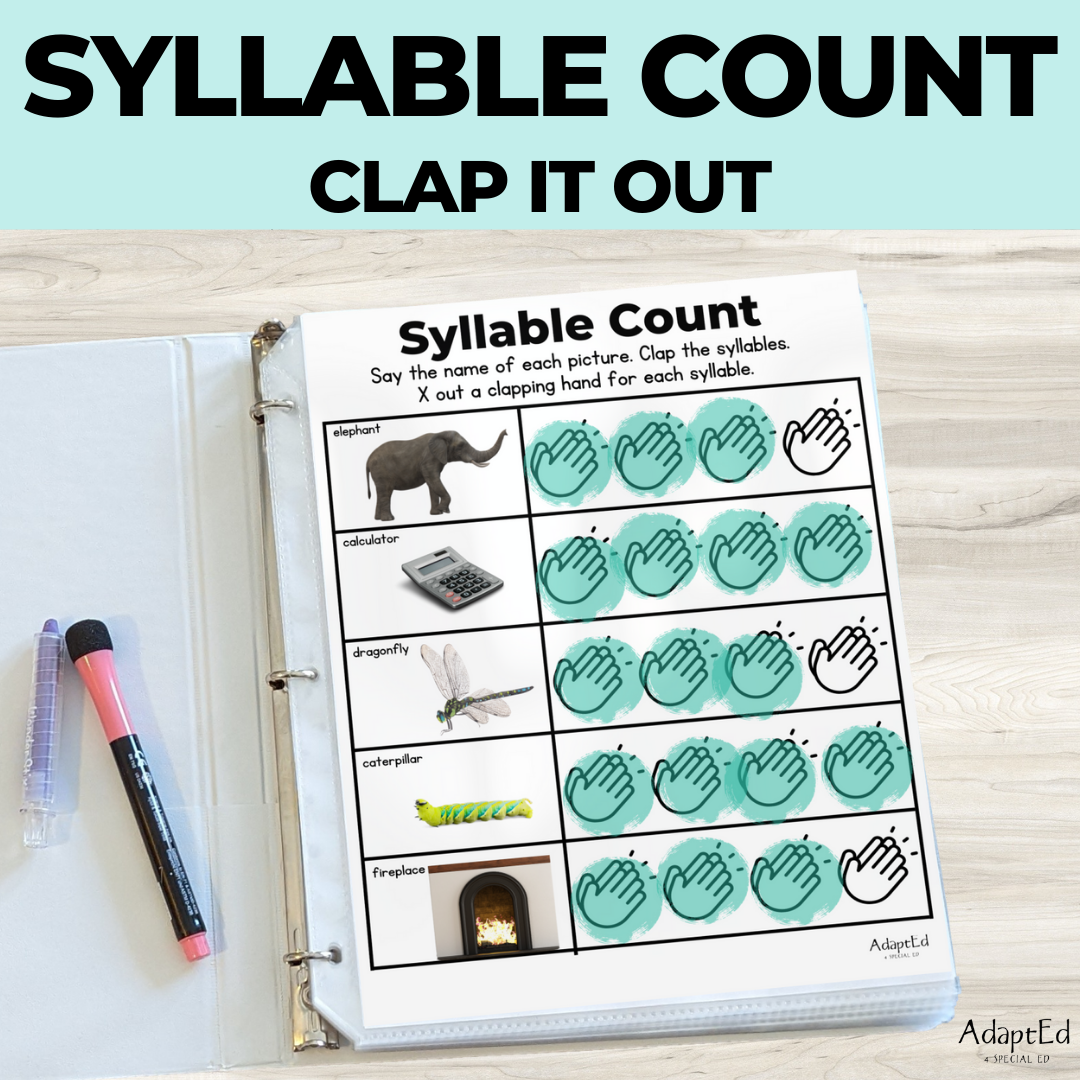
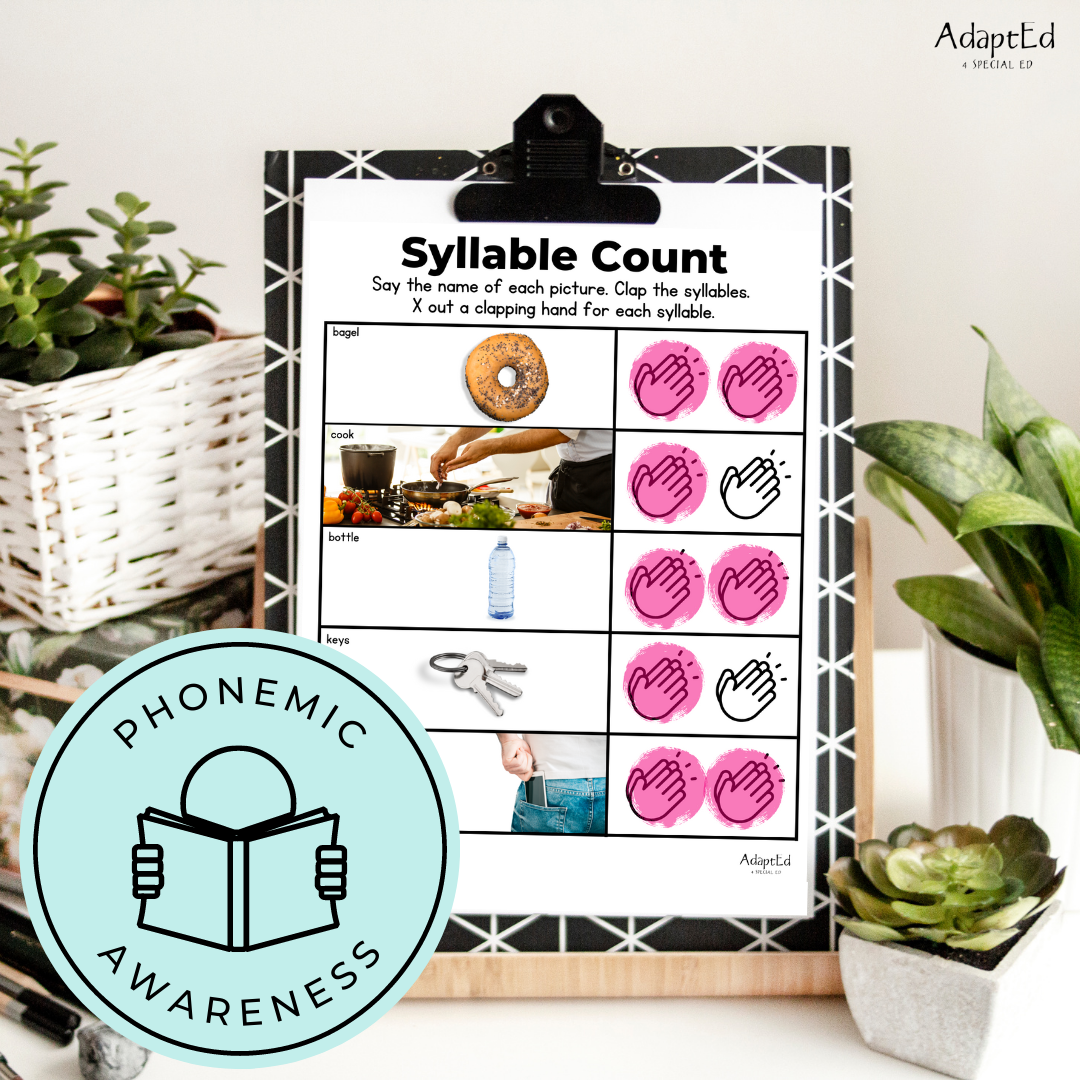
Counting Syllables: Clap It Out
If you're looking for a fun, hands-on way to help your students master syllable and phonemic awareness skills, then you need AdaptEd’s Counting Syllables. With 175 different words ranging from 1 to 5 syllables, this activity is perfect for use in ELA centers, literacy centers, and workstations. Repetition with variety is key to success with this important skill, and AdaptEd provides plenty of both.
Plus, these Syllable Counting pages can be used over and over again - making them a great value for your classroom. So don't wait - get AdaptEd’s Counting Syllables today and see the difference it makes in your students' reading abilities!
✅ SAVE TIME! - The syllable counting pages are easy to prep and can be used over and over again.
✅ EASY TO DIFFERENTIATE! - Ranges from 2-5 syllable hand icons on the page. 1-5 syllables per word.
✅ KEEPS KIDS ENGAGED! This is a fun and motivating way to teach kids how to count syllables and practice phonological awareness.
✅ EASY TO USE!
Identify the picture
Determine the number of syllables (claps)
Draw an X on the clapping hands icon for each syllable in the word.
✅ VERSATILE!
This versatile product can be used as an independent activity, in small groups, or with the whole class. Just have the kids identify the picture, determine the number of syllables, and draw an X on the clapping hands icon for each syllable.
You can also bind the pages into a phonemic awareness practice workbook. Either way, your students are sure to love this fun and motivating way to learn!
Here's what you'll get:
35 syllable counting pages
These rhyming word games can be used simply as matching games for centers or the cards can be placed face down and they can be used as concentration games.
The concentration games will require students to focus in order to match the appropriate word pairs. I have included two sets of cards. The first set includes pictures with words that rhyme. The second set of cards has only pictures. These can be used for an advanced level of game play or for a student who is struggling to find the rhyming words.
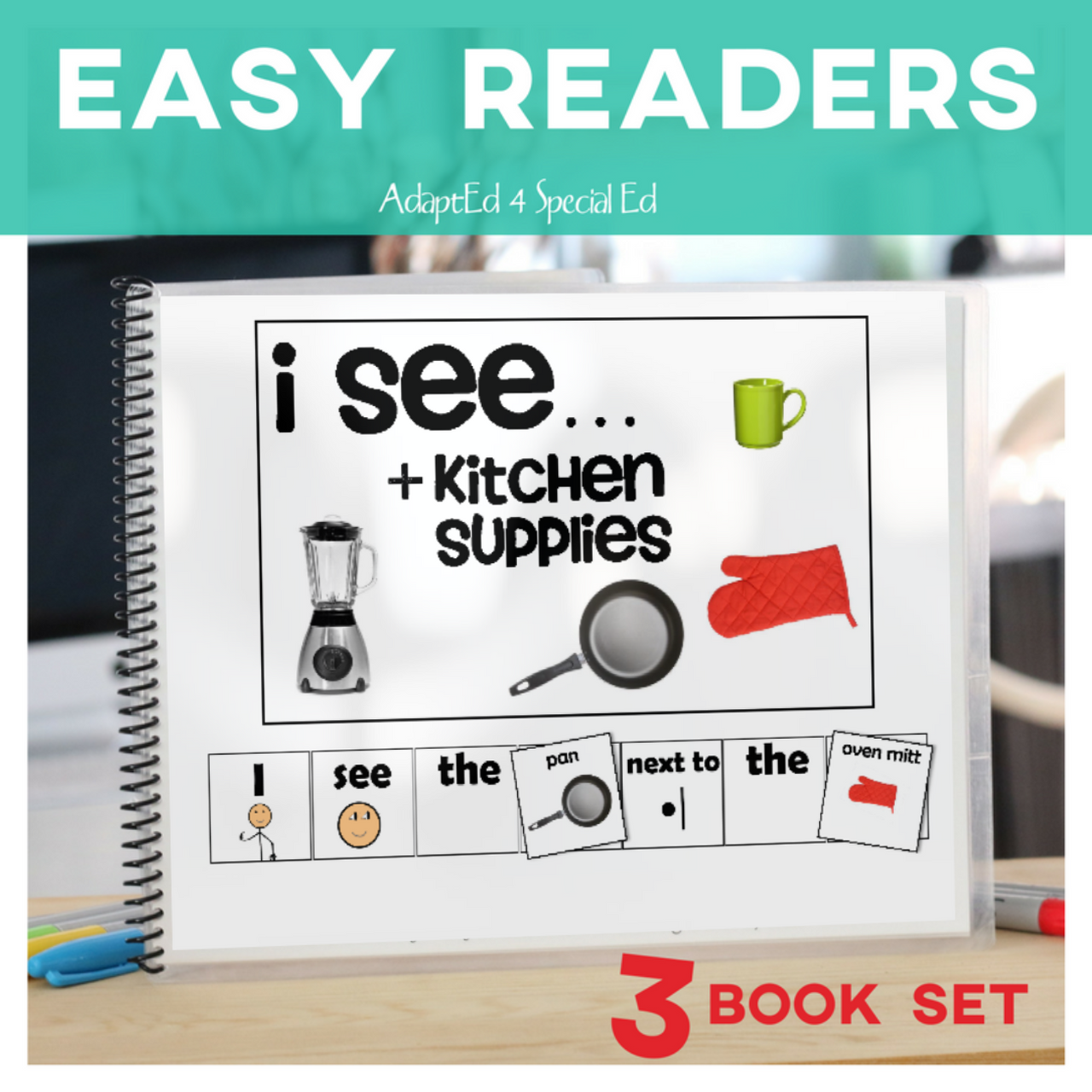
Emergent Reader: I see... Kitchen Supplies (Printable PDF)
Easy Reader Adapted Books- Increase students MLU, and Vocabulary Development (mean length of utterance) with this adapted book, while helping them to learn concepts about print, and beginning sight words.
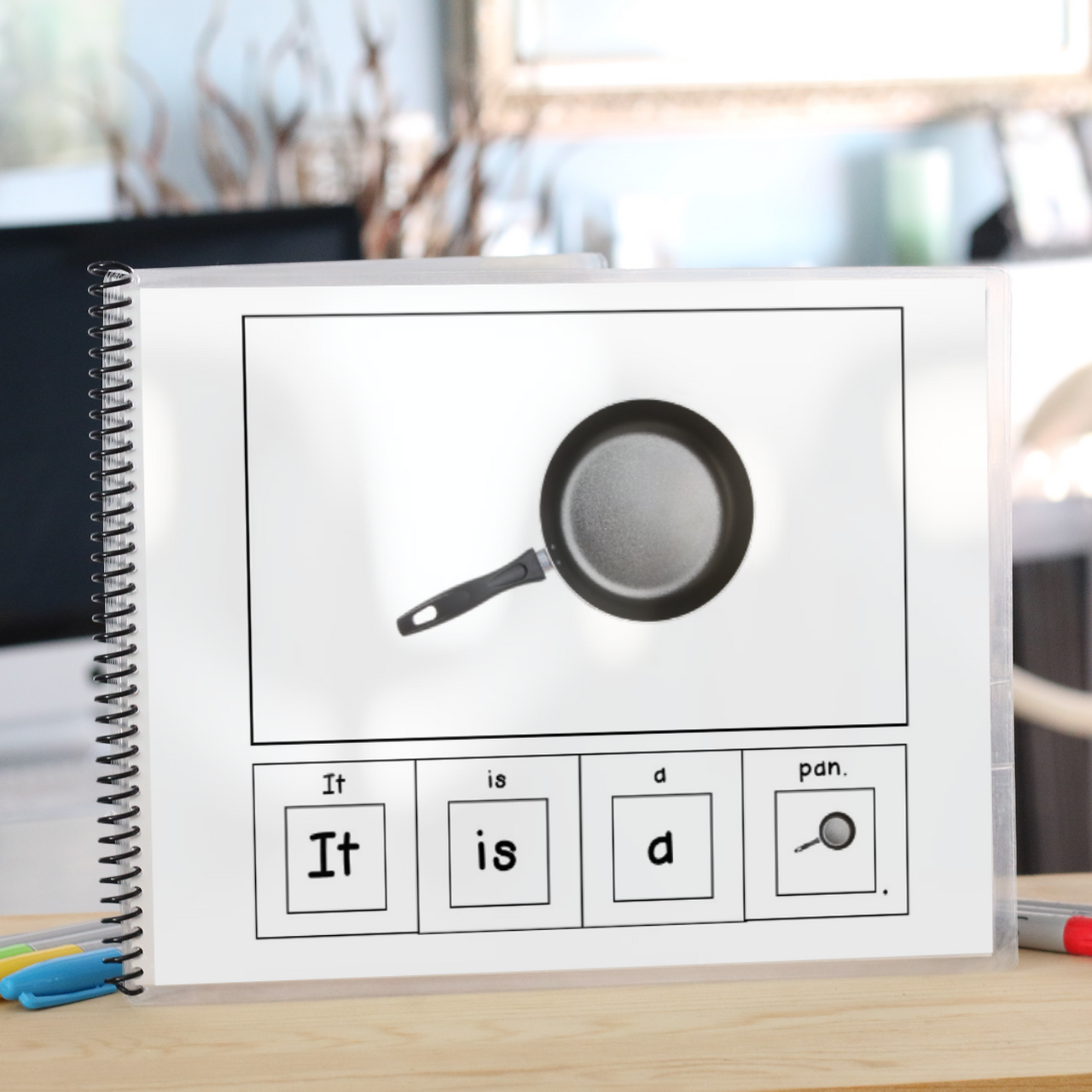
Allow them to enjoy reading, from the start with these fun/ interactive adaptive books.The student can either read the sentence strip at the bottom of the page, or use the adaptable pieces to match the corresponding pictures to create a sentence. (Ex: I see a pot.)
Earliest readers can use the visual supports at the bottom of each page to find success right away.
What's Included: 3 Kitchen Supplies Easy ReadersPicture/ Word PiecesSentence Strip3 Kitchen Supplies Easy Readers
It is a ____.
29-page book
I see a ____ and a ______.
13 page book with 2 options Read/ Fill in the blanks.
I see a ____ next to a ______.
13 page book with 2 options Read/ Fill in the blanks.
Kitchen Supplies: pan, barbecue, pot, spatula, large spoon, stove, blender, microwave, plate, oven mitt, bowl, knife, spoon, fork, ladle, refrigerator, cup, mug, cookie sheet, rolling pin, measuring cup, strainer, wooden spoon, whisk, cutting board, spatula, grater, mixerAll books come with sentence strip and Picture/ Word PiecesSentence Strip makes this an interactive reading experience, have your students build the sentence as they read or fill in the blanks.Builds Confidence In Your Early Readers
Your student can either read the sentence strip at the bottom of the page.
Use the adaptable pieces to fill in the blanks, or match the corresponding pictures to create a sentence.

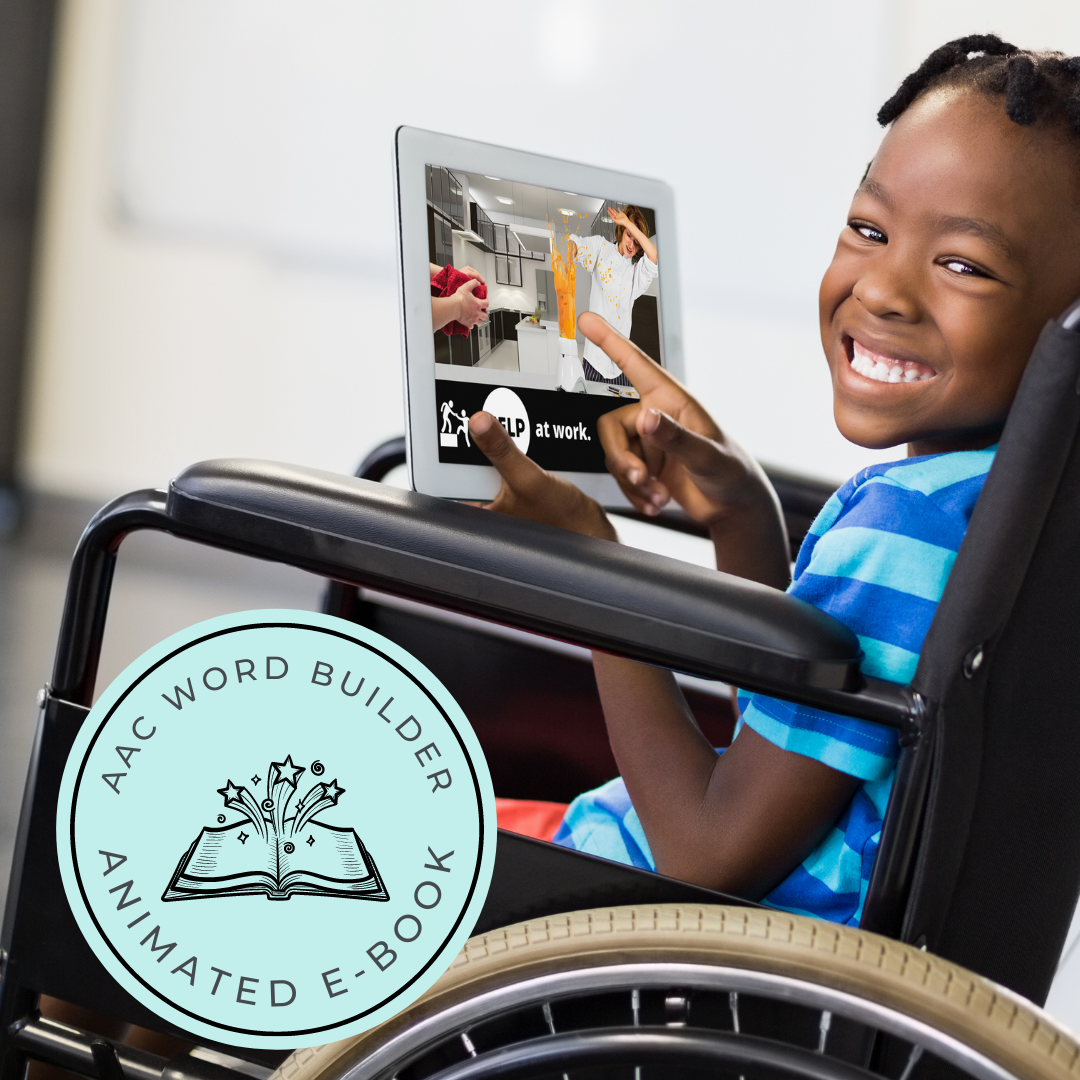
AAC Core Word Builder Set 1 | 20 Weeks of No-Prep Speech Therapy Lessons for SLPs
Just 80 words make up about half of everyday English. This curriculum teaches the first ones that matter most.
AAC Core Word Builder: Set 1 is the first 20 weeks of a structured, year-long curriculum designed to teach foundational core vocabulary systematically — turning isolated words into real, generalized communication.
Created by Meg Mott, M.S., CCC-SLP, AdaptEd's resident AAC specialist and parent of an autistic son. Originally built for teletherapy in 2020 and refined across years of real classroom and clinic use, this curriculum is now trusted by SLPs, special educators, and AAC teams across the country.
Set 1 covers 17 high-frequency core words across 20 weeks — including extended two-week instruction for Go, Turn, and Not/Don't because high-utility words deserve deeper repetition.
What this curriculum gives you
20 weeks of ready-to-use AAC lessons — no prep beyond opening the file
A consistent weekly structure across all 20 lessons, so students know what to expect
Multi-modal activities that engage attention, body, and family — not just the screen
Generalization built in through parent handouts and homework that extend learning beyond the session
A clear progression from first words to functional communication across settings
Who this is for
SLPs looking for structured, evidence-aligned AAC instruction without spending Sunday nights building lessons from scratch
Special education teachers supporting students with complex communication needs who want a curriculum they can actually run
Teletherapy and hybrid clinicians who need engaging, screen-friendly materials that hold attention across digital sessions
AAC teams looking for shared lesson materials that align across providers, classrooms, and home
Parents wanting to extend AAC learning at home with structured guidance, not just generic suggestions
What's inside each weekly lesson
Each of the 20 weeks centers on one core word, taught through seven coordinated activities:
Introductory GameA low-pressure activity individually crafted for each lesson, designed to introduce the target word without performance pressure.
Animated E-BookReal photographs arranged into a unique book for each word — minimum 10 pages, with movement on every page to hold attention and reinforce the word in context.
Movement BreakA targeted movement activity tied to the target word — from a simple linked dance video to a custom movement game — that builds regulation into the lesson.
Additional ActivityAn extra engagement that may center on a song, a video, a book extension, or a guided drawing, giving you variation across the week.
Parent HandoutA take-home guide for every word, so families have direction for practicing core vocabulary at home and learning generalizes across settings.
HomeworkA simple homework activity, easily shared electronically — including a flexible "book report" format that works any week of the curriculum.
The 17 core words you'll teach in Set 1
These are the words that unlock the most communication for the least effort. Three of them — Go, Turn, and Not/Don't — get a second week of instruction because their utility justifies the deeper practice.
Go (2 weeks)
Turn (2 weeks)
Not/Don't (2 weeks)
Eat
Come
Put
Help
Like
Open
Want
All Done
More
What?
I/You
On
Off
Drink
Continue the curriculum with Set 2 and Set 3
Set 1 is the foundation. The full curriculum continues with another 40 weeks of core vocabulary across two additional sets:
Set 2 — 20 more weeks featuring Stop, Look, Up, Good, Make, Work, In, Read, Take, and more.
Set 3 — 20 final weeks featuring Big, Where, Feel, Give, Fast, Slow, Ready, Away, and more.
Buy each set individually as you progress through the year, or save $30 with the Complete Curriculum Bundle (Sets 1–3, 60 weeks of lessons).
Formats, delivery & purchase orders
💻 Digital download — instant access after purchase
📱 Works on iPad, laptop, Chromebook, or any device with internet access
🎓 Compatible with teletherapy, push-in, pull-out, and home use
Purchase orders accepted. Email service@adapted4specialed.com
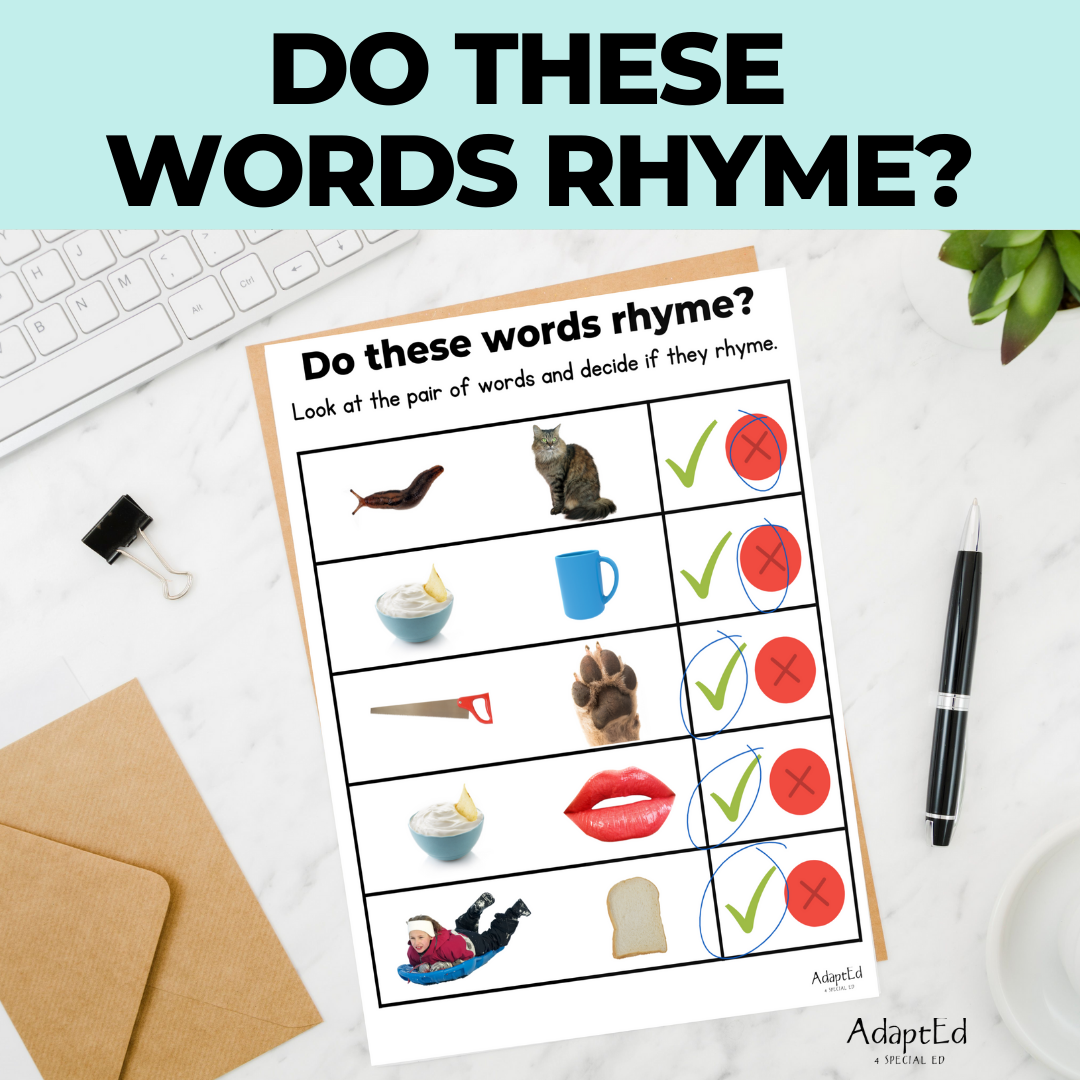
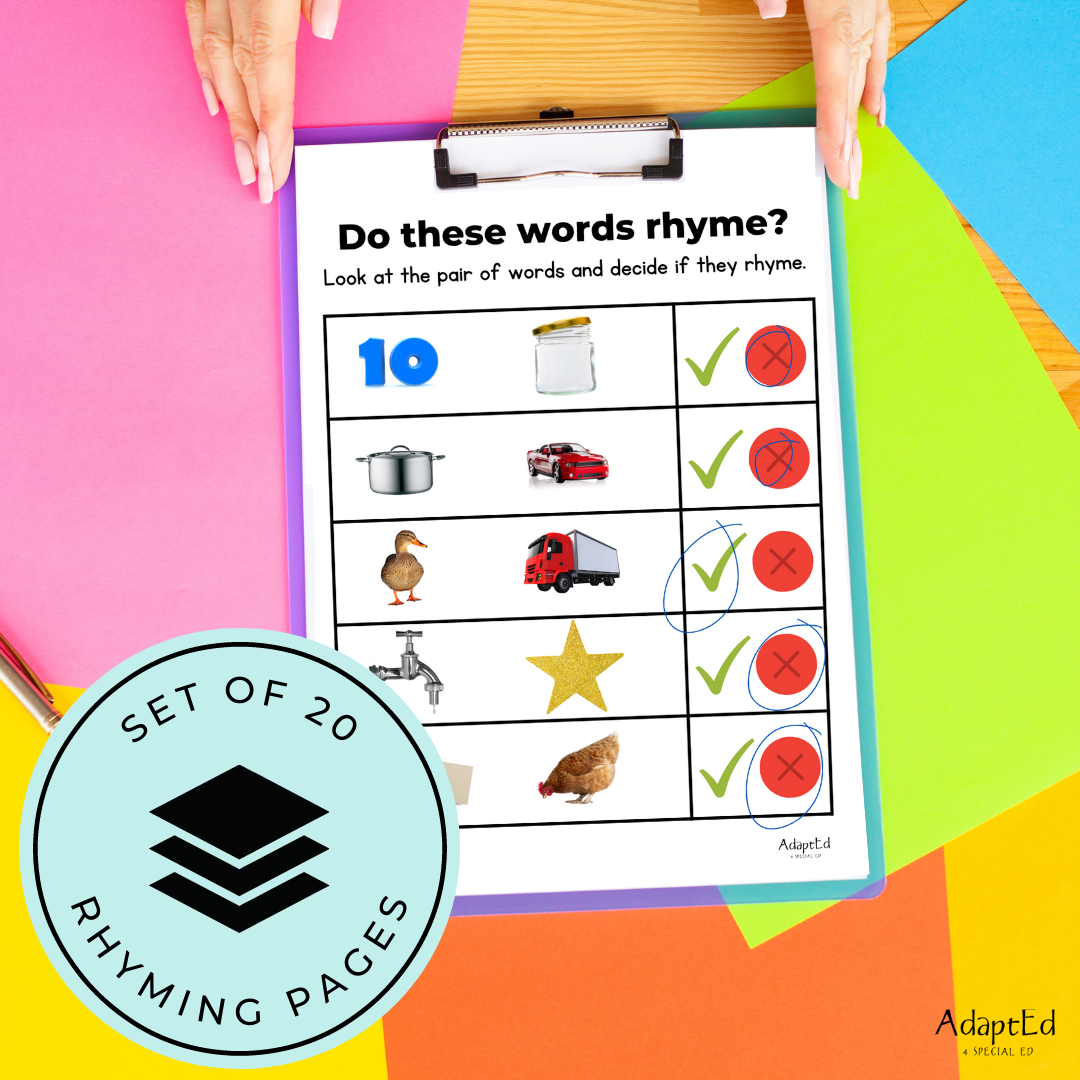
Do These Words Rhyme? Phonemic Awareness Activity
Looking for a fast, fun, and effective way to teach phonological/phonemic awareness skills? Look no further than AdaptEd's Do these words rhyme?
By identifying if the two words rhyme, students will develop an important skillset that will help them become better readers, spellers, and writers. This activity is perfect for Pre-K to 1st grade students, either in a classroom setting or at home.
20 worksheets / 100 pairs of rhyming words
This set is ideal to be used with:
Special Education
Beginning Readers
Struggling Readers
Pre-K to 1st Grade (RTI)